The Communal Meal as Neuroarts Practice - Vagal Foods - an Experiment in Embodied Learning
November 19th, 2026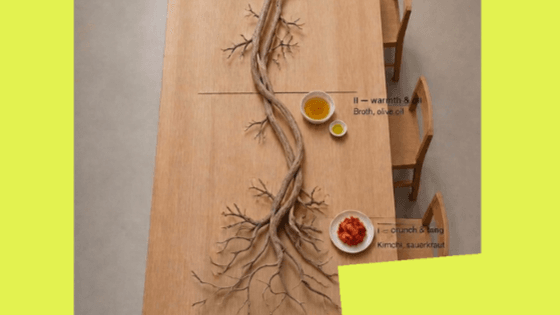
“Listen to your body” may be the most repeated and least understood instruction in health communications or actually, more often, in wellness. The problem is not that it is wrong. It is that it treats a perceptual skill as though it were a simple directive, as if the capacity to detect and interpret internal bodily signals were always available, waiting to be switched on by an instruction.
The neuroscience suggests otherwise. Interoception -the brain’s ability to sense the body’s internal state- is not a binary capacity. Researcher Sarah Garfinkel and colleagues have described it as multidimensional: how accurately you detect internal signals, how much you believe you perceive them, and how well those two things align. Some people are accurate but unaware of it; others feel intensely but misread the signals. Interoceptive accuracy, awareness, and sensibility can diverge substantially within the same individual (Garfinkel et al., Philosophical Transactions of the Royal Society B, 2016).
This means interoception is a skill -one that can be cultivated, or quietly eroded when life does not leave room for it.
What would it mean to design an experience that creates conditions for interoceptive attention to emerge, rather than simply instructing people to pay attention?
The installation: a communal table as anatomical map
On 29 September 2026, at Vienna Design Week, I presented Vagal Foods, a participatory installation built around this question.
The physical structure was a long communal table. Running along its center, wooden branches traced the anatomy of the vagus nerve through the body - as an object occupying the same space as the participants, readable laterally while tasting. The vagus nerve, the longest cranial nerve, originates in the brainstem and descends through the neck and thorax to the digestive organs. Approximately 80% of its fibers carry information from the body to the brain. It is, structurally, an organ of listening.
The table was organized around three culinary stations, each anchored in a distinct line of research:
Crunch & Tang: fermented foods. A randomized trial at Stanford (Wastyk et al., Cell, 2021) showed that a diet high in fermented foods increased gut microbiome diversity and reduced inflammatory markers in healthy adults. The gut microbiome communicates with the brain via the gut-brain axis, a well-documented mechanism still being mapped in detail (Cryan et al., Physiological Reviews, 2019).
Warmth & Oil: bread and extra virgin olive oil. A four-year randomized clinical trial associated a Mediterranean diet supplemented with olive oil with better cognitive outcomes in older adults compared to a low-fat control diet (Valls-Pedret et al., JAMA Internal Medicine, 2015).
By Hand: 100% cacao chocolate, offered and shared hand to hand. The focus here was not only the food, but the gesture. Research exploring the relationship between positive social interaction and vagal tone (Kok et al., Psychological Science, 2013) informed the design of this station.
The sequence was deliberate: participants tasted, felt, and paused. The science came afterward- as a frame for what had already happened in the body.
Why the sequence matters: sensation before cognition
Conventional health literacy formats deliver information first and expect behavioral or attitudinal change to follow. The evidence for this model is weak, because declarative knowledge and embodied knowledge are encoded differently and do not reliably convert into one another.
The Vagal Foods design inverted this sequence. Each station was constructed so that participants encountered a somatic event - a texture, a temperature, a shared act - before receiving any explanatory framing. The cards on the table described sensation and mechanism. Scientific content arrived as a named companion to something already experienced in the body.
This is not a novel pedagogical principle; embodied learning has a long literature. What is less explored is its application in public-facing health communication, particularly at the intersection with neuroarts. The question Vagal Foods poses is not whether people can understand the vagus nerve, but whether a sensory experience can become an entry point into interoceptive awareness - and whether that awareness is a more durable substrate for health literacy than information alone.
On epistemic honesty: what this installation can and cannot claim
The discourse around the vagus nerve has acquired a significant noise problem. Social media has reframed it as a stress-reset lever, with promises the evidence does not support. This made scientific rigor a design constraint.
So my working principle was: poetry on the table, rigor in the back pocket.
What participants read was simple and sensory. What stood behind each sentence was a citation I could hand to a skeptical neurologist. The installation’s scientific advisor, Assistant Prof. Mag. Dr. Isabella Anderson-Wagner, reviewed the menu and all written materials before the event. I also maintained a written document specifying what claims the installation could and could not make.
What can be sustained: each station is grounded in a real line of peer-reviewed research. The direct evidence for brain outcomes remains formative - a point the nutritional psychiatry literature itself acknowledges (Adan et al., European Neuropsychopharmacology, 2019). The installation did not treat anything. What it offered was a context for participants to attend to their own bodies.
The distinction matters for the neuroarts field more broadly. The gap between "this experience activates specific neural pathways" and "this experience produces measurable health outcomes" is real, and collapsing it too quickly does damage to both the science and the practice.
Embodied transfer: the evidence from the room
One moment during the event crystallized what an embodied learning format can do that an informational format cannot.
A group of schoolchildren explored the installation, taking notes. When asked whether they had understood, they explained immediately what the vagus nerve is. A teenager, without being prompted, explained it to her peers, in her own words, pointing to the table.
She had understood something through a physical experience and could reconstruct it from that understanding. This is the mechanism: information that passes through a body is retained differently than information that passes through a text.
A member of the team reflected afterward: "I was surprised how few people knew the vagus nerve exists. Why do we look for answers in the stars when we don’t know what happens inside our own bodies?"
Interoception is an ability that is cultivated in practice and eroded when life does not leave space for it. An installation cannot restore that capacity in a single afternoon. But it can make it visible - create a moment in which someone becomes aware that there is a signal to listen to.
The space as argument: a corporate meeting room
The original concept specified a simple wooden table. The space offered was a corporate meeting room: polished surface, ergonomic chairs, cold light.
My initial instinct was to resist. On reflection, the mismatch was the argument. Corporate meeting tables are where sustained stress pushes the nervous system toward prolonged vigilance: attention directed outward, toward deadlines and others’ needs, while subtler internal signals are overwritten or ignored. Placing an installation about interoception and vagal listening precisely there reframes the space: this is the table where it matters most to calibrate your nervous system before deciding.
The constraint became the content.
An open question for the field
Vagal Foods is not a scalable program in its current form. It is, perhaps, an indicator of a methodological gap and a direction.
The neuroarts field has developed substantial evidence for arts-based interventions in clinical and therapeutic contexts. What is less developed is the application of neuroarts thinking to public health communication: formats that use sensory and aesthetic experience not to treat, but to build health literacy at the level of felt knowledge rather than declarative knowledge.
A one-day installation with no campaign budget generated an authentic transfer moment: a teenager explaining the vagus nerve to her peers, unprompted. This suggests that the format is worth taking seriously as a research question: Can sensory, design-led experiences reliably activate interoceptive attention? Can that attention function as a durable entry point into health literacy? What would a research protocol for this look like?
These are questions that sit at the intersection of neuroarts, interoception research, and health communication. They seem worth asking together, including at the level of funding and cultural policy.
In an age of information saturation, what keeps people engaged is not more information. It is the feeling that something has already happened in them - and the curiosity to understand what.
References:
Adan, R.A.H. et al. (2019). Nutritional psychiatry: Towards improving mental health by what you eat. European Neuropsychopharmacology, 29(12), 1321–1332.
Cryan, J.F. et al. (2019). The microbiota-gut-brain axis. Physiological Reviews, 99(4), 1877–2013.
Garfinkel, S.N. et al. (2016). Knowing your own heart: Distinguishing interoceptive accuracy from interoceptive awareness. Philosophical Transactions of the Royal Society B, 371(1708).
Kok, B.E. et al. (2013). How positive emotions build physical health: Perceived positive social connections account for the upward spiral between positive emotions and vagal tone. Psychological Science, 24(7), 1123–1132.
Valls-Pedret, C. et al. (2015). Mediterranean diet and age-related cognitive decline. JAMA Internal Medicine, 175(7), 1094–1103.
Wastyk, H.C. et al. (2021). Gut-microbiota-targeted diets modulate human immune status. Cell, 184(16), 4137–4153.
Scientific advisor: Ass. Prof. Mag. Dr. Isabella Anderson-Wagner. Installation design: Allan Berger, Sabine Rauth, Michael Salge, Andra Bria.