hyper_object
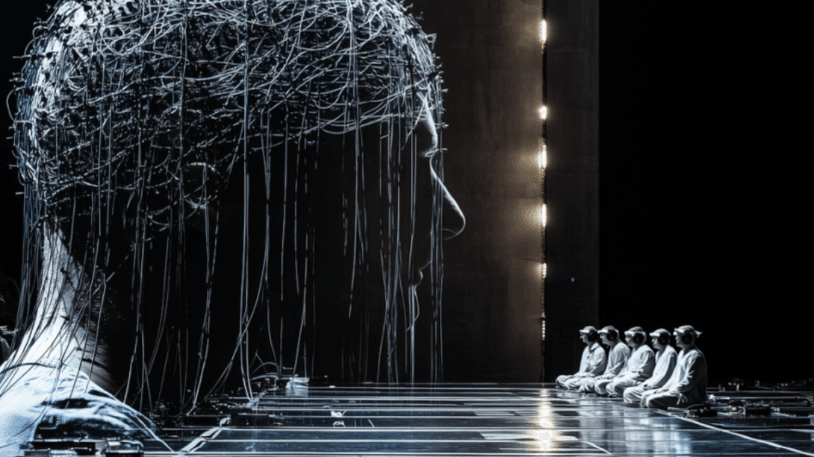
hyper_object is a new immersive neuro-theater performance created, written, and directed by Graham Sack, an assistant research professor with the Berman Institute of Bioethics, in collaboration with an interdisciplinary team of artists and engineers from across Johns Hopkins.
Blending live theater, artificial intelligence (AI), wearable neurotechnology, and interactive media, hyper_object tells the story of a mysterious planet that can perceive the thoughts of humankind. The production asks profound questions about the relationship between human intelligence, AI, and planetary intelligence at the beginning of the 21st century.
The performance explores how brain-computer interface technology and AI can reshape the future of live performance, immersive media, and interactive storytelling. Actors and a select group of audience members wear electroencephalogram (EEG) headsets that measure patterns of brain activity. These real-time signals control a responsive audiovisual environment, including multi-surface video projections, a generative music and sound design, and responsive dialogue system. At the center of the work is the "hyper_object": a virtual character representing a sentient planet that responds to human brainwaves. As performers and spectators generate live neural data, the performance environment shifts around them.
Set aboard an international space station orbiting a mysterious exoplanet, hyper_object follows a crew of scientists studying an intelligence beyond the limits of human understanding. As the planet begins to evoke visions, memories, and unconscious fears, the crew must confront the possibility that the entity they are studying may understand them more deeply than they understand themselves. Through both its story and its form, the production raises urgent questions about AI, neurotechnology, and the future of human identity. What happens when machines can interpret signals we may not fully understand? How do biometric systems change the boundary between performer and spectator, mind and machine, individual and collective experience?
The project was developed with support from a Nexus Research Award and the Dracopoulos-Bloomberg iDeas Lab at the Berman Institute of Bioethics.