Public Space as a Living Lab: Scientific Protocols for Human Dynamics
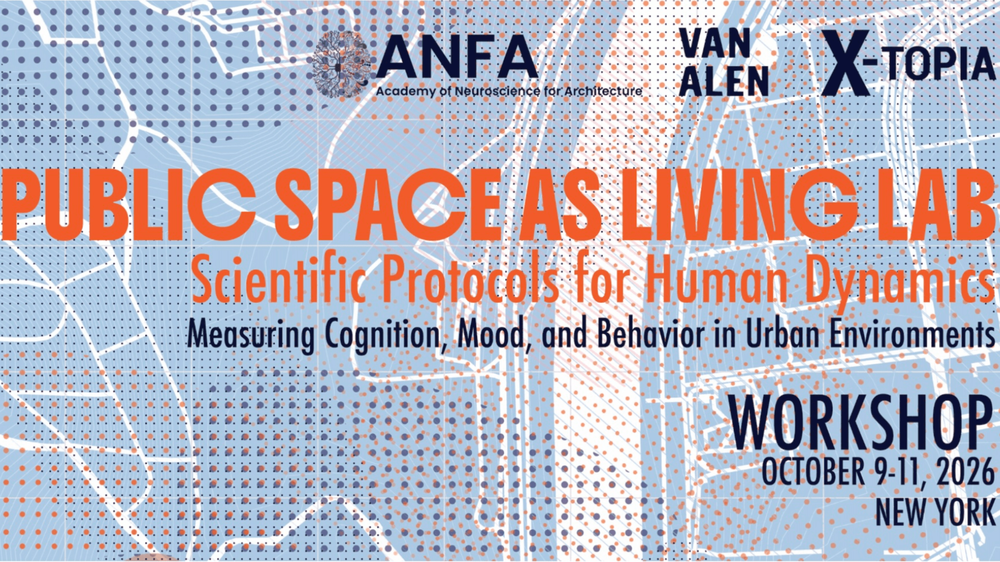
Public Space as a Living Lab is a 3-day, hands-on workshop exploring how small, reversible public-space interventions influence cognition, mood, and behavior. Bringing together urban design, environmental psychology, neuroscience methods, and technology, participants will learn tools to measure human experience and translate evidence into healthier, more livable, human-centered design strategies.
Public Space as a Living Lab is a three-day immersive workshop introducing architects, urban designers, planners, researchers and public-sector professionals to scientific protocols for measuring human experience in public space. Rather than relying exclusively on observations or questionnaires, participants learn how to combine physiological, cognitive, affective and behavioral methods into one coherent field protocol. Participants experience the workshop from three perspectives: researcher, subject and observer. Through repeated role changes they learn not only how evidence is collected, but also how methodological decisions influence interpretation.
This workshop bridges environmental psychology, neuroscience, architecture and urban design by teaching participants how to formulate hypotheses, collect evidence in real urban settings and translate results into future design decisions. More than a workshop, it is an immersive learning experience where participants will gain practical tools to design healthier, more livable, and human-centered public spaces while exploring innovative approaches at the intersection of design, science, and technology.
The workshop combines lectures, fieldwork, rapid prototyping, data collection, and collaborative synthesis. It will take place across outdoor public spaces — where interventions and measurements will be tested — and indoor spaces hosted by the Van Alen Institute, where lectures, tools training, synthesis sessions, presentations, and group debriefs will take place.
Participants will work across three parallel tracks:
- Cognition & Navigation: How do people orient themselves, remember landmarks, make decisions, and move through urban environments?
- Mood, Stress & Restoration: How do public spaces affect emotional state, perceived restoration, stress, comfort, and attention?
- Behavior & Social Interaction: How do spatial conditions influence dwelling, encounter, movement, seating, and collective use of public space?
Who is this for?
This workshop is open to students, professionals, researchers, and civic practitioners interested in the relationship between people and the built environment. It is especially relevant for architects, urban designers, landscape architects, planners, public-sector professionals, researchers, students, recent graduates, community organizations, and anyone interested in evidence-based approaches to public space, health, behavior, and urban life. No prior experience with neuroscience or data collection is required.
Learning Outcomes
By the end of the workshop participants will be able to formulate hypotheses, choose appropriate measurement tools, design standardized field protocols, collect multimodal data, understand limitations, avoid overclaiming, and translate evidence into design recommendations.
Participants will learn how to:
- understand the theoretical foundations of public space, livability, placemaking, and human-centered/ evidence-based urban design
- explore how interdisciplinary fields such as environmental psychology and neuroscience inform the design and evaluation of public spaces
- study cognition, mood, and behavior in public-space settings
- use basic field protocols to evaluate human experience
- work with observational, self-report, behavioral, and physiological measures
- prototype and test small-scale reversible interventions
- translate findings into evidence-based design strategies
- communicate insights to broader audiences
- develop actionable recommendations to improve the livability, well-being, and user experience of public spaces