Artist-Led Origination: Before the Hypothesis
March 17th, 2026
New York City, New York, United States
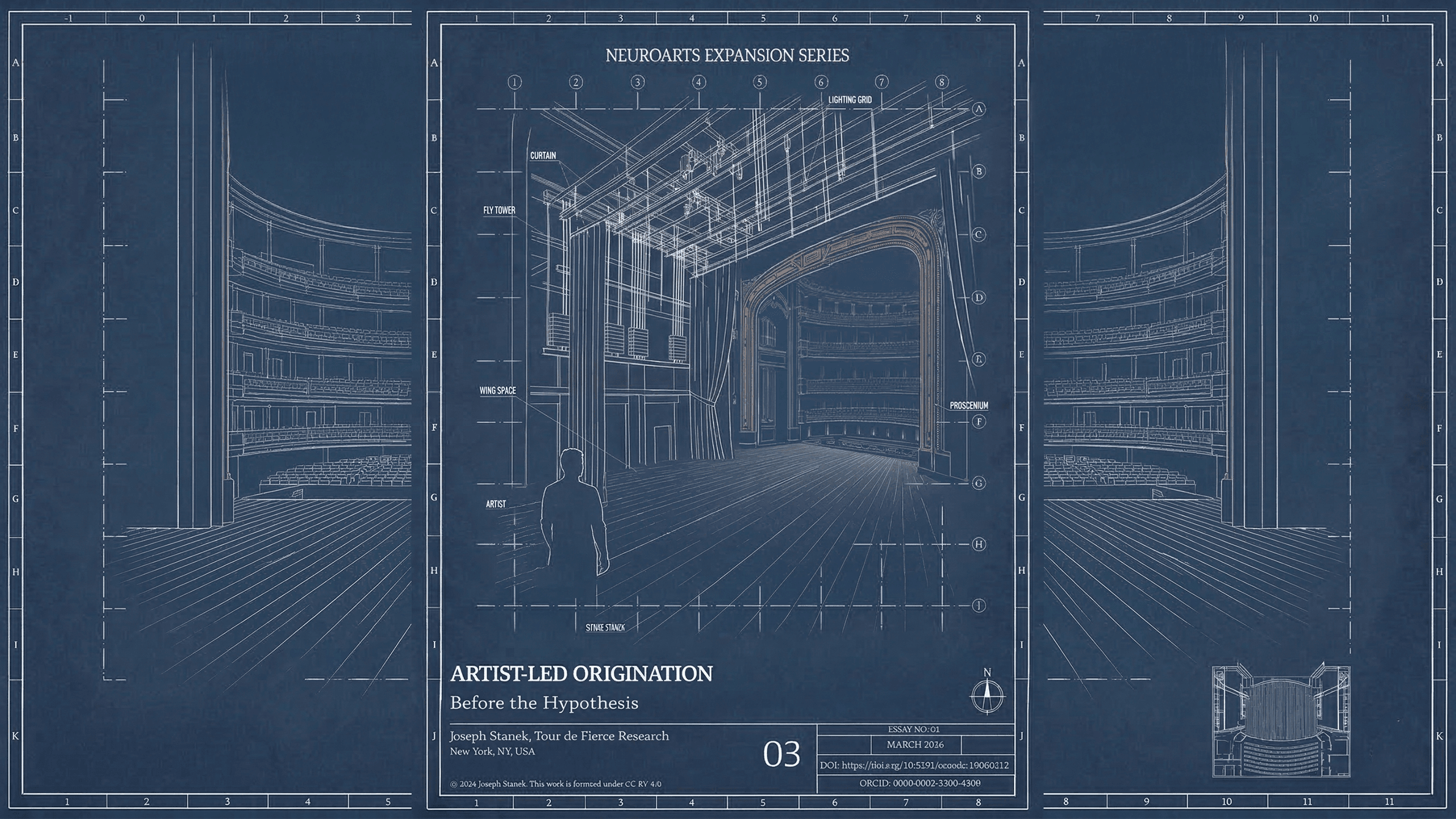
Introduces Artist-Led Origination (ALO) as a foundational NeuroArts framework in which artistic practice generates research questions prior to hypothesis formation. Defines Artist-Initiated Inquiry and Practice-Led Inquiry, introduces Diachronic Aesthetic Knowledge, and positions ALO as a core structural pillar of the NeuroArts Expansion Series.
DOI: 10.5281/zenodo.19060212
Posted byJoseph Stanek
Pending staff verification
Notify
Abstract/Description
NeuroArts has built its identity around equal partnership between artists and scientists, yet the formal architecture of inquiry within the field tells a different story. This essay addresses that asymmetry directly.
Artist-Led Origination: Before the Hypothesis establishes Artist-Led Origination (ALO) as a formal epistemological principle within NeuroArts: research agendas may legitimately originate from the lived expertise of practitioners operating within Applied Aesthetic Contexts, because certain classes of aesthetic phenomena may not enter the field's investigative purview through any other pathway — and because inquiry originating from that expertise deserves consideration within the same evaluative structures that govern institutionally supported research.
The essay identifies two operational modes through which ALO functions: Artist-Initiated Inquiry, in which practitioners formulate explicit research questions derived from sustained professional observation, and Practice-Led Inquiry, in which knowledge emerges through iterative cycles of artistic creation, refinement, and response. It positions these within a three-stage knowledge lifecycle — origination, evaluation, and execution — clarifying that ALO expands the range of phenomena that may enter investigation while preserving the evaluative standards through which all research proposals are assessed.
The essay also introduces Diachronic Aesthetic Knowledge as a named conceptual contribution: the practitioner's accumulated capacity to perceive aesthetic phenomena across time, functioning simultaneously as a detector of emerging cultural dynamics and as an interpreter of historically transmitted aesthetic systems.
Positioned as the conceptual core of the NeuroArts Expansion Series, this work establishes a research architecture in which artistic practice and scientific inquiry operate as reciprocally informing systems — advancing the field through expansion rather than displacement.
DOI: [Click here]
Full research hub: [Click here]
Artist-Led Origination: Before the Hypothesis establishes Artist-Led Origination (ALO) as a formal epistemological principle within NeuroArts: research agendas may legitimately originate from the lived expertise of practitioners operating within Applied Aesthetic Contexts, because certain classes of aesthetic phenomena may not enter the field's investigative purview through any other pathway — and because inquiry originating from that expertise deserves consideration within the same evaluative structures that govern institutionally supported research.
The essay identifies two operational modes through which ALO functions: Artist-Initiated Inquiry, in which practitioners formulate explicit research questions derived from sustained professional observation, and Practice-Led Inquiry, in which knowledge emerges through iterative cycles of artistic creation, refinement, and response. It positions these within a three-stage knowledge lifecycle — origination, evaluation, and execution — clarifying that ALO expands the range of phenomena that may enter investigation while preserving the evaluative standards through which all research proposals are assessed.
The essay also introduces Diachronic Aesthetic Knowledge as a named conceptual contribution: the practitioner's accumulated capacity to perceive aesthetic phenomena across time, functioning simultaneously as a detector of emerging cultural dynamics and as an interpreter of historically transmitted aesthetic systems.
Positioned as the conceptual core of the NeuroArts Expansion Series, this work establishes a research architecture in which artistic practice and scientific inquiry operate as reciprocally informing systems — advancing the field through expansion rather than displacement.
DOI: [Click here]
Full research hub: [Click here]