Creative experiences and brain clocks
October 3rd, 2025
Agustin Ibanez, Nisha Sajnani, Lucia Melloni, Christopher Bailey, Ian H. Robertson, Brian Lawlor, Robert Whelan, Carlos Coronel-Oliveros, Joaquin Migeot, Fernando Lehue, Lucia Amoruso, Natalia Kowalczyk-Grębska, Natalia Jakubowska, John Fredy Ochoa-Gómez, Javier Escudero, Görsev G. Yener, Gaetano Di Caterina, Daniel Abasolo, Claudio Babiloni, Bahar Güntekin, Jasmin Bonilla-Santos, Alfredis González-Hernández, Hernando Santamaria-Garcia , Sandra Baez, Aneta Brzezicka, Jil M. Meier, Martin Schürmann, Laura Kaltwasser, Adolfo M. García, Ruaridh A. Clark, Rodrigo A. Gonzalez-Montealegre, Renato Anghinah, Pedro A. Valdes-Sosa, Martin A. Bruno, Marcio Soto-Añari, Kanad N. Mandke, Joana Pereira Seabra, Patricio Orio, Dominic Campbell, Raul Gonzalez-Gomez, Pavel Prado, Jhosmary Cuadros, Enzo Tagliazucchi, Josephine Cruzat, Agustina Legaz, Vicente Medel, Hernan Hernandez, Sol Fittipaldi, Florencia Altschuler, Sebastian Moguilner
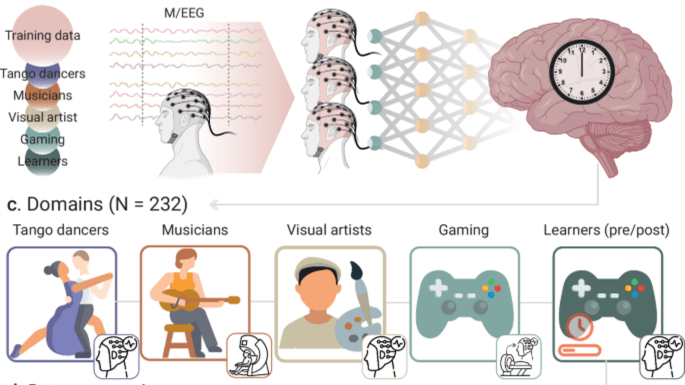
A new study finds that sustained creative activity—across music, art, dance, and video games—is linked to delayed brain aging, as measured by EEG-based “brain clocks.” Researchers analyzed data from over 1,200 participants, showing that higher expertise and learning in creative domains help maintain brain efficiency and connectivity in age-vulnerable regions.
Nature Communications
DOI: https://doi.org/10.1038/s41467-025-64173-9
Posted bySamuel Garrett
Pending staff verification
Notify
Abstract/Description
Creative experiences may enhance brain health, yet metrics and mechanisms remain elusive. We characterized brain health using brain clocks, which capture deviations from chronological age (i.e., accelerated or delayed brain aging). We combined M/EEG functional connectivity (N = 1,240) with machine learning support vector machines, whole-brain modeling, and Neurosynth metanalyses. From this framework, we reanalyzed previously published datasets of expert and matched non-expert participants in dance, music, visual arts, and video games, along with a pre/post-learning study (N = 232). We found delayed brain age across all domains and scalable effects (expertise>learning). The higher the level of expertise and performance, the greater the delay in brain age. Age-vulnerable brain hubs showed increased connectivity linked to creativity, particularly in areas related to expertise and creative experiences. Neurosynth analysis and computational modeling revealed plasticity-driven increases in brain efficiency and biophysical coupling, in creativity-specific delayed brain aging. Findings indicate a domain‑independent link between creativity and brain health.