Guest Blog Post: The Institute for Arts Integration and STEAM

A few years ago, my husband Kevin and I celebrated our anniversary with a trip to Charleston, South Carolina. While there, we visited the Angel Oak tree just outside the city. Considered the largest live oak east of the Mississippi, this towering giant is estimated to be over four hundred years old. Its trunk spans an astonishing twenty-five feet in circumference, with sprawling, gnarled branches stretching wide enough to cast over seventeen thousand square feet of shade.
Standing beneath those massive limbs, I felt more than awe at its size and beauty. I was struck by its sheer endurance. This tree has weathered centuries of storms, stood firm through both the Civil and Revolutionary Wars, and silently witnessed the rise and fall of entire civilizations. It has survived hurricanes, earthquakes, and relentless human expansion, yet it continues to grow.
The Angel Oak's strength comes partly from its ability to adapt, but even more from the way its roots and branches work together. Deep roots anchor it, providing stability and nourishment, while its sprawling branches stretch outward, each playing a vital role in the tree's survival.
Creativity works exactly the same way.
Beyond Silos: A Framework for Creative Development
Education has long been obsessed with subjects in silos. Math lives in one room, science in another, and the arts (when they survive budget cuts) occupy their own separate corner. Even when schools do focus on creativity, they treat it as a single, undifferentiated thing. It's like coaching "athleticism" without distinguishing between strength, endurance, and coordination. We talk about creativity in vague terms but rarely teach students how to actually access and activate it.
This matters now more than ever. As artificial intelligence (AI) reshapes every industry, the World Economic Forum identifies creativity, problem-solving, and emotional intelligence as the skills machines cannot replicate. Yet our education systems remain structured around content delivery and standardized assessment, leaving creative development to chance.
In my book, Creativity's Edge: Unleashing Humanity's Greatest Advantage in the Age of AI (Bloomsbury Academic, February 2026), I introduce a framework called the Four Branches of Creativity. Like the Angel Oak's branches, each serves a distinct purpose while remaining connected to the whole.
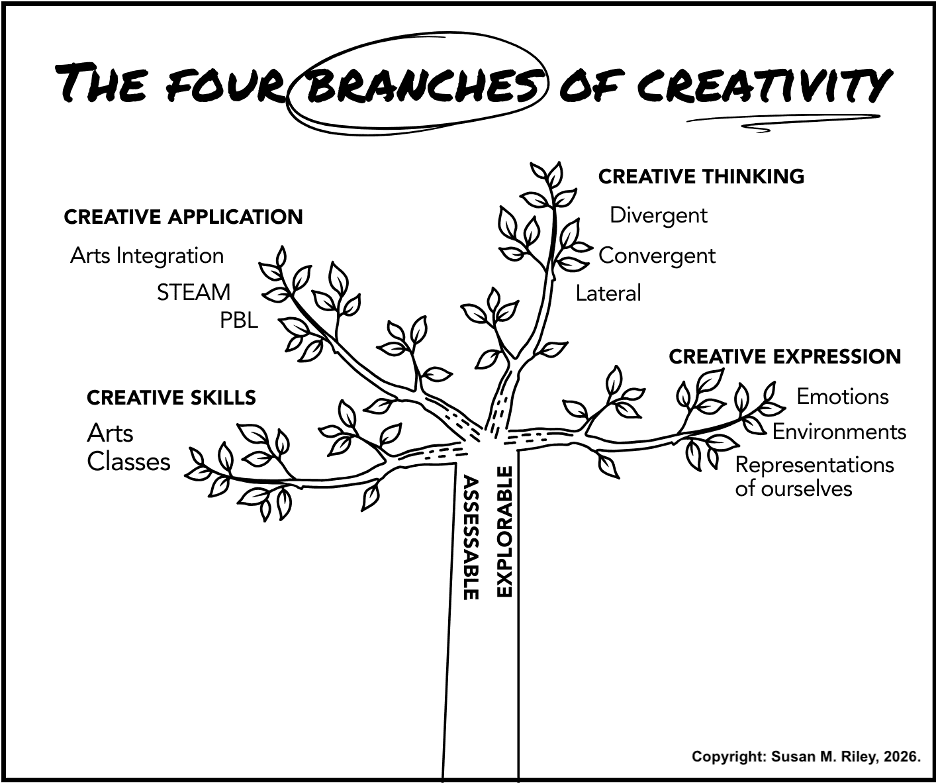
Creative Skills are the technical abilities we can directly teach and assess: brushwork, musical notation, coding syntax, the craft elements of any discipline.
Creative Thinking is where innovation develops, the mental agility to see problems from multiple angles and make unexpected connections.
Creative Expression is how we represent our unique perspective on the world, processing experiences and emotions through creative practice.
And Creative Application is where everything converges, where ideas meet reality and transform into solutions that actually work.
These branches don't operate in isolation. They form an ecosystem where each element nourishes the others. A software developer might use creative skills to write elegant code, creative thinking to solve complex problems, creative expression to design intuitive interfaces, and creative application to implement solutions that improve people's lives.
The Neuroscience Connection
This framework isn't just theoretical. It's grounded in what neuroscience reveals about how creative capacity develops.
During creative tasks, something remarkable happens in the brain: the default mode network and executive control network stop taking turns and begin working in concert. It's like a neural jazz improvisation where networks that normally compete suddenly find harmony.
The arts don't just provide a nice outlet for self-expression. They physically change the brain, building neural pathways that strengthen our capacity for creative thinking across every domain. When we engage in creative activities, we strengthen connections between our imagination center and our focusing system. We produce more brain-derived neurotrophic factor, which helps neurons form new connections. We build cognitive reserve, the backup pathways that allow us to find new routes when primary ones are blocked.
The neuroarts field validates what practitioners have long observed: the arts aren't extras to be cut when budgets get tight. They're essential cognitive tools that build capacity for the kind of thinking our world demands.
Supporting Creative Application in Practice
At The Institute for Arts Integration & STEAM, we focus particularly on that fourth branch, Creative Application, because it's where theory meets reality. Through approaches like arts integration, STEAM education, and project-based learning, we help schools create environments where students don't just learn about concepts but apply them to meaningful challenges.
We provide professional development, a national annual conference, online courses, resources, and a global community for educators committed to integrating the arts across disciplines. Our work reaches educators in every state and over fifty countries, from classroom teachers looking to infuse creativity into daily practice to district leaders redesigning curriculum for an uncertain future.
The results are compelling: schools that intentionally use these approaches see student achievement rise by ten percent or more across the board. Students become active participants in their learning. Teachers feel empowered rather than constrained. And most importantly, students develop the critical thinking, problem-solving, and adaptability they'll need for careers that don't yet exist.
An Invitation
Like the Angel Oak, creativity thrives when its different elements work together, when roots run deep and branches stretch wide. The neuroarts field provides the scientific foundation for understanding how this happens in the brain, giving us a roadmap for intentional creative development.
Creativity's Edge released on February 19, 2026 and is available everywhere books are sold. To learn more about The Institute for Arts Integration & STEAM and access resources for developing creativity in your own practice, visit artsintegration.com.