Guest Blog Post: The Society for the Neuroscience of Creativity
What makes someone creative? For decades, scientists avoided this question entirely: creativity seemed too subjective, too mysterious to study. But understanding how and why humans create matters. It shapes how we solve problems, express ourselves, and make meaning in our lives.
For much of the twentieth century, psychology focused on intelligence, perception, and learning, while creativity was dismissed as too subjective to be studied systematically. That’s changed dramatically. Eleven years ago, the Society for the Neuroscience of Creativity was founded to advance the scientific study of creativity and its neurological underpinnings. As this field advances, our members are leading the way in understanding creativity not just as a cognitive skill, but as a fundamental form of human expression that engages the whole person.
The Evolution of Creativity Science
The shift began in the 1950s, when J. P. Guilford argued that creativity should be understood as a form of human intelligence. In his presidential address to the American Psychological Association, Guilford challenged psychologists to study the structure of intellect more broadly, proposing that creative thinking could be decomposed into measurable components: fluency, flexibility, originality, and elaboration.
By treating creativity as something that could be operationalized and quantified, Guilford made creativity scientifically tractable. Divergent thinking tasks, insight problems, and creative achievement measures emerged as tools for studying how people generate novel ideas and solutions. This laid the groundwork for decades of work on the mental processes that support creativity, positioning creativity science firmly within the traditions of established fields like cognitive psychology.
Creativity in the Brain
At the turn of the new millennium, as cognitive neuroscience developed, neuroimaging methods like fMRI and EEG enabled researchers to study creativity in the brain. However, these tools demanded even greater precision and control. Neuroimaging required tightly controlled, repeatable tasks with clear timing and measurable responses: simplified paradigms like divergent thinking or insight problems that could isolate specific mental operations.
These highly structured approaches demonstrated that creative thinking could be reliably linked to patterns of brain activity, and challenging popular myths, like the idea that creativity is purely “right-brained”. The neuroscience of creativity entered the mainstream, and we’ve learned so much.
As our findings accumulated, we’ve come to understand that creativity emerges from interactions among large-scale brain networks, not from any single brain region or hemisphere. Creative thinking involves both spontaneous and controlled components, relying on memory, attention, executive control, and subjective preferences.
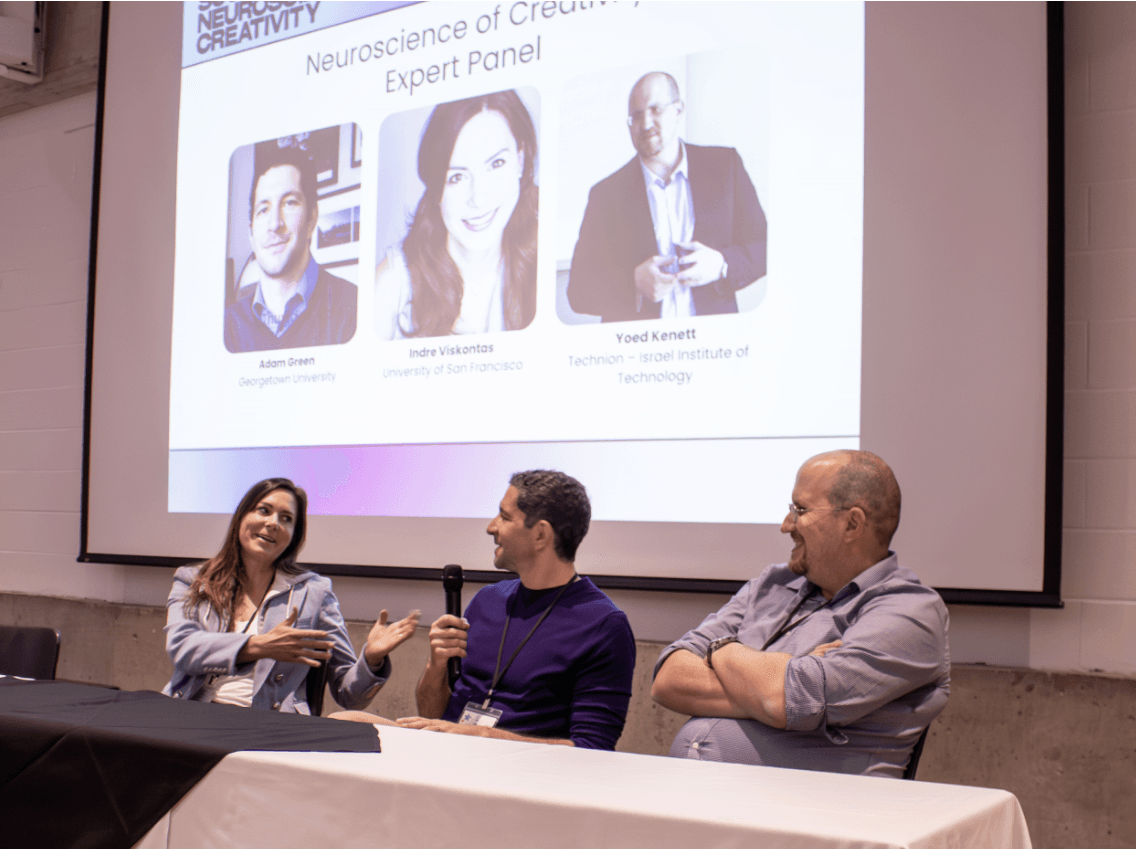 SfNC Executive Committee in action.
What Was Missing
The structure of these tasks shaped what counted as creativity in the laboratory. Short bursts of idea generation were easier to capture than extended creative expression. And because most neuroimaging methods require participants to keep their heads still, studying brain activity during artistic and embodied forms of creativity, such as drawing, playing music, dancing, or creating with the body, was nearly impossible.
What remains are the most cognitive and abstract parts of creativity, such as idea generation processes that underlie brainstorming, innovation, and problem-solving. Understanding these elements of creativity is important and valuable, but not the entire picture. Emotional meaning, artistic development over time, and the lived experience of creating were harder to study. Artistic creativity was often treated as a special case rather than a central object of study.
As creativity research matured, it increasingly intersected with education, business, and technology. The World Economic Forum has repeatedly identified creative thinking as a core skill for the future workforce. Creativity became valued for its usefulness and economic impact, which benefited from existing measures and paradigms, but also reinforced a focus on outcomes rather than experience.
It created a paradox. The science of creativity became more rigorous, but sometimes moved further from the forms of creativity that matter to most people. How does art move us? How does creative expression generate meaning? How does emotion shape what we make? These questions weren't unimportant, they were just harder to study.
The tasks and paradigms from early research remain valuable. Recognizing their limits doesn't diminish their importance: good science requires understanding what they can and cannot tell us. The science of creativity had to begin cautiously to establish legitimacy. That foundation is now firmly laid, and neuroscience methods have advanced substantially. That's where our work comes in.
A Fuller Vision of Creativity
At the Society for the Neuroscience of Creativity, we define creativity broadly. Our members study creative thinking and innovation, but also aesthetic experience, insight, imagination, and artistic expression across domains. Contemporary research from our community recognizes creativity as a set of processes that span generation, evaluation, expression, and reception. Creativity involves not only producing new ideas, but also interpreting and responding to the creative work of others.
Recent work by our members examines how humans create with artificial intelligence, how technology reshapes creative processes, and how people respond to AI-generated creative output. This reflects a growing consensus: creativity cannot be reduced to a single ability or outcome. It is a dynamic interaction among cognitive, emotional, and social systems.
The theme of our 2026 meeting, Liberty to Create, signals our renewed commitment to studying creativity not only as a tool for problem solving, but as a fundamental form of human expression. Creativity is not valuable only because it improves performance or wellbeing, but because it allows people to explore, communicate, and construct meaning.
Understanding creativity in this fuller sense does not require abandoning rigor. It requires expanding our questions. From Guilford's early efforts to measure creativity as intelligence to current work examining creative experience in the brain, the trajectory of the field points towards expansion and integration. Creativity uses the whole brain, but it also engages the whole person.
At the Society for the Neuroscience of Creativity, we bring together researchers, practitioners, artists, and educators committed to understanding how and why humans create across all domains and expressions. As we prepare for our 2026 meeting, we invite the Neuroarts community to join this conversation.
Get involved:
- Learn more about the Society for the Neuroscience of Creativity and our SfNC2026: Liberty to Create at tsfnc.org
- Join our community of researchers, artists, and practitioners exploring creativity and the brain
- Share your work at the intersection of creativity neuroscience and the arts
- Connect with us on LinkedIn and Bluesky