Guest Blog Post: TimeSlips Creative
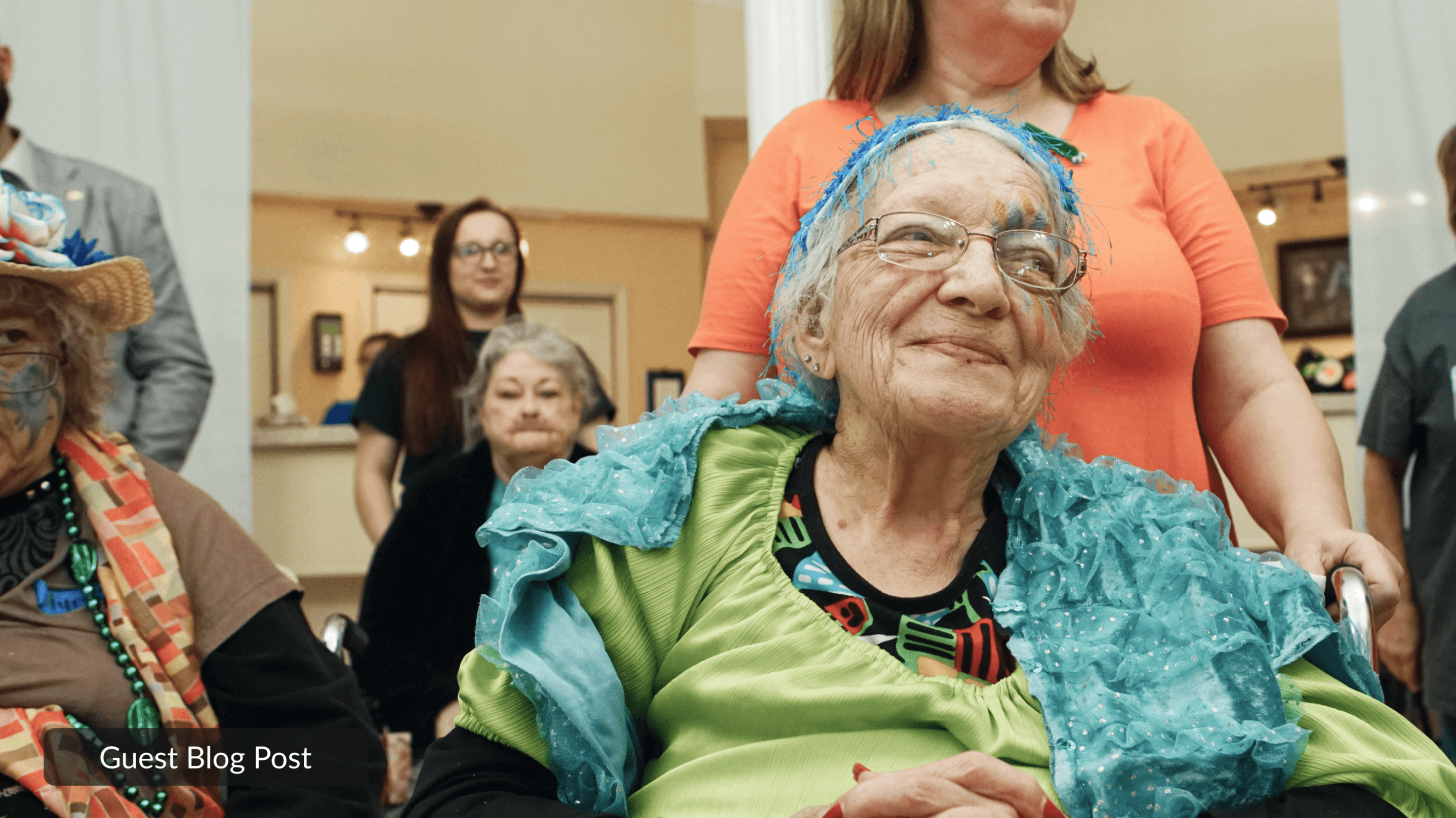
“It’s like a breath of fresh air. Like you are bringing the sun into the room.”
The losses that dementia can bring, in its many forms, can be overwhelming.
At its simplest, TimeSlips’ Creative Care approach trains caregivers and volunteers to see beyond those losses to connect with the creative soul that remains and invite them into joyful meaning making.
HOW IT EMERGED
TimeSlips began back in 1998, when I found myself on a locked Alzheimer’s unit. Amidst the pulsing alarms and blaring televisions in the common room, I was trying to engage the 4-5 hearty souls who had been good enough to work with me each week as I tried to get them to talk about their favorite memories. Of holidays. Of music. Of pets. Of meals.
Faced with the direct question - “do you remember…?” most would look at me quizzically, the neuro-pathway for that answer to travel clogged by the debris known as plaques and tangles.
One day, I shifted tactics and invited the group to make up a story together. I brought in an image as a prompt and invited them to say anything they wanted. They had control. They could name the figure in the image. They could say where and when it took place. They had the power to shape narrative - and I would echo anything they said and weave it into a story.
It was as though we had been sitting in the dark for six weeks and someone had suddenly turned on the lights.
There was laughter and singing. There was much cajoling and congratulating of each other. We were suddenly a group of storytellers, feeling the power of playing with expression.
In our magic circle of imagination, they could make meaning again with whatever tools they had - gesture, sound, facial expressions, words.
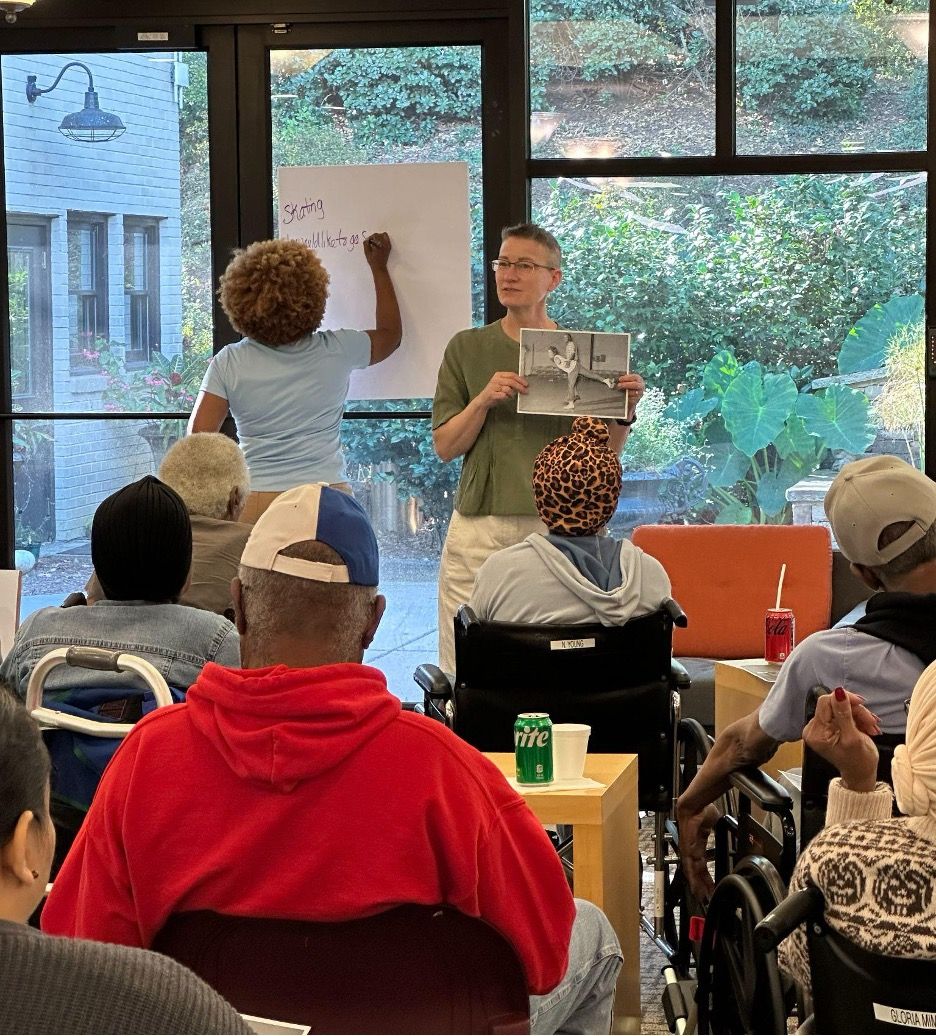 New Trainers Sonya Williams and Joan Meggitt facilitate a TimeSlips session at AG Rhodes in Atlanta, GA. Photo credit: Timeslips
 HOW IT WORKS
The stories that emerged from those sessions, and the thousands of sessions by the 1,300 active Certified Facilitators across the world since then, are both poignant and hilarious - a blend of hope, regret, playfulness, and raw effort to express and connect with the world around them.
Over a dozen research studies on the TimeSlips approach to improvisational “storytelling” - shaping any mode of expression into a collage-like story - suggest that by affirming all expression, this approach increases communication and improves quality of life for people with dementia; and reduces stress, improves attitudes toward dementia, and improves quality of life among caregivers. A full summary of the research studies can be found here.
The mechanisms at the root of TimeSlips’ approach are common to many co-creative arts & health programs: 1) imagination-based co-creation is an accelerant to meaningful social connection; 2) when fact-based memory is inaccessible, imagination offers many more pathways for expression and increases communication; 3) a clear social role as a storyteller affirms social identity and value, and reduces confusion; 4) co-shaping a creative product creates a gift that can be shared with others to lessen stigma and isolation; 5) creative playfulness (the root of learning) expands cognitive reserve and slows brain aging.
HOW IT IS EVOLVING - AND EXPANDING
TimeSlips has evolved considerably over its long history. Over the past year, we reimagined our training programs with an eye toward scaling to infuse this simple meaning-making approach into every touchpoint of health and social care for older adults and their care partners. We work with
- Professional caregivers in residential and homecare systems;
- Organizations that support family caregivers such as support groups or corporate employee wellness programs.
- High school and colleges to train students as volunteers;
- Community-based Aging Services teams offering meal delivery, well-check calls, senior center programming or memory cafes.
Our two-step training pathway begins with becoming a Certified Facilitator in virtual or in-person Facilitator Workshops. Certified Facilitators are eligible to attend a Trainer Institute (there will be 5 in 2026!) as an Organizational Trainer (you can certify people within your organization) or an Independent Trainer (TimeSlips contracts with you to offer Facilitator Workshops near you).
We are in the process of adapting our web-based Creativity Center, with over 400 Story Starters (Beautiful Questions and images) to a mobile app that facilitators can use to prepare for, conduct, and evaluate a session. Integrated AI will offer guidance on how to phrase questions more openly - or what we call “more beautifully,” to invite imagination and co-creation.
It has been incredibly thrilling to watch the field of Arts & Health / Neuroarts emerge so strongly over the last decade - deepening the research partnerships and reframing the arts as an integral part of whole health. Our dream is to scale our approach by infusing it into care systems so that every moment of care can become an opportunity for meaning-making.
The enormous need for meaningful social connection among older adults, people with dementia and their caregivers demands ambitious goals. TimeSlips is launching a campaign to create 10 Million Moments of Joy and Connection over the next 5 years, by training 1,000 Trainers and 25,000 caregivers. Our strategy is to form strategic partnerships to expand across care systems. Join us!
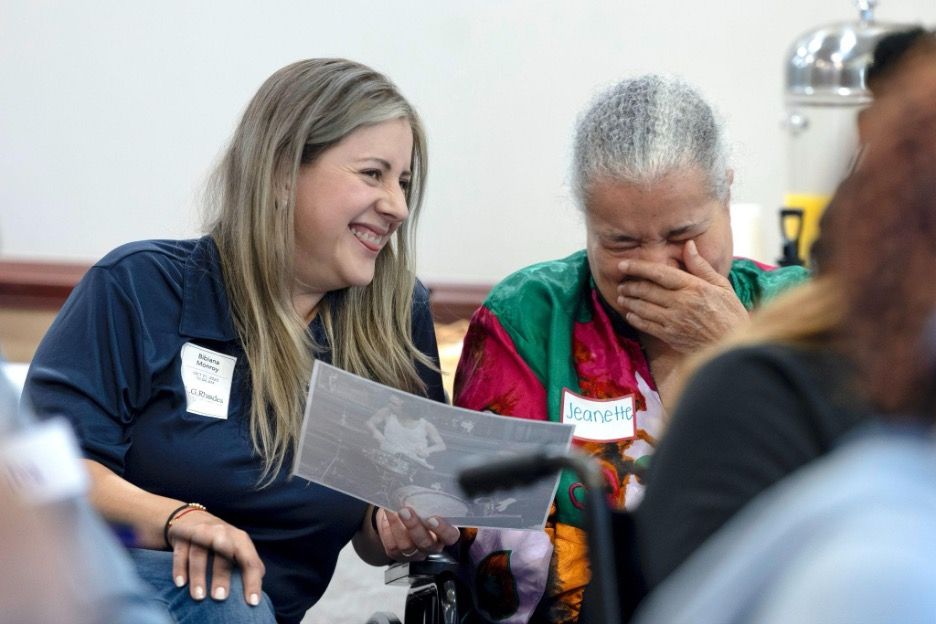 A moment of joy and connection at AG Rhodes in Atlanta, GA. Photo credit: Timeslips