Perception of wood materials via multisensory cues
January 6th, 2015
Waka Fujisaki, Midori Tokita, Kenji Kariya
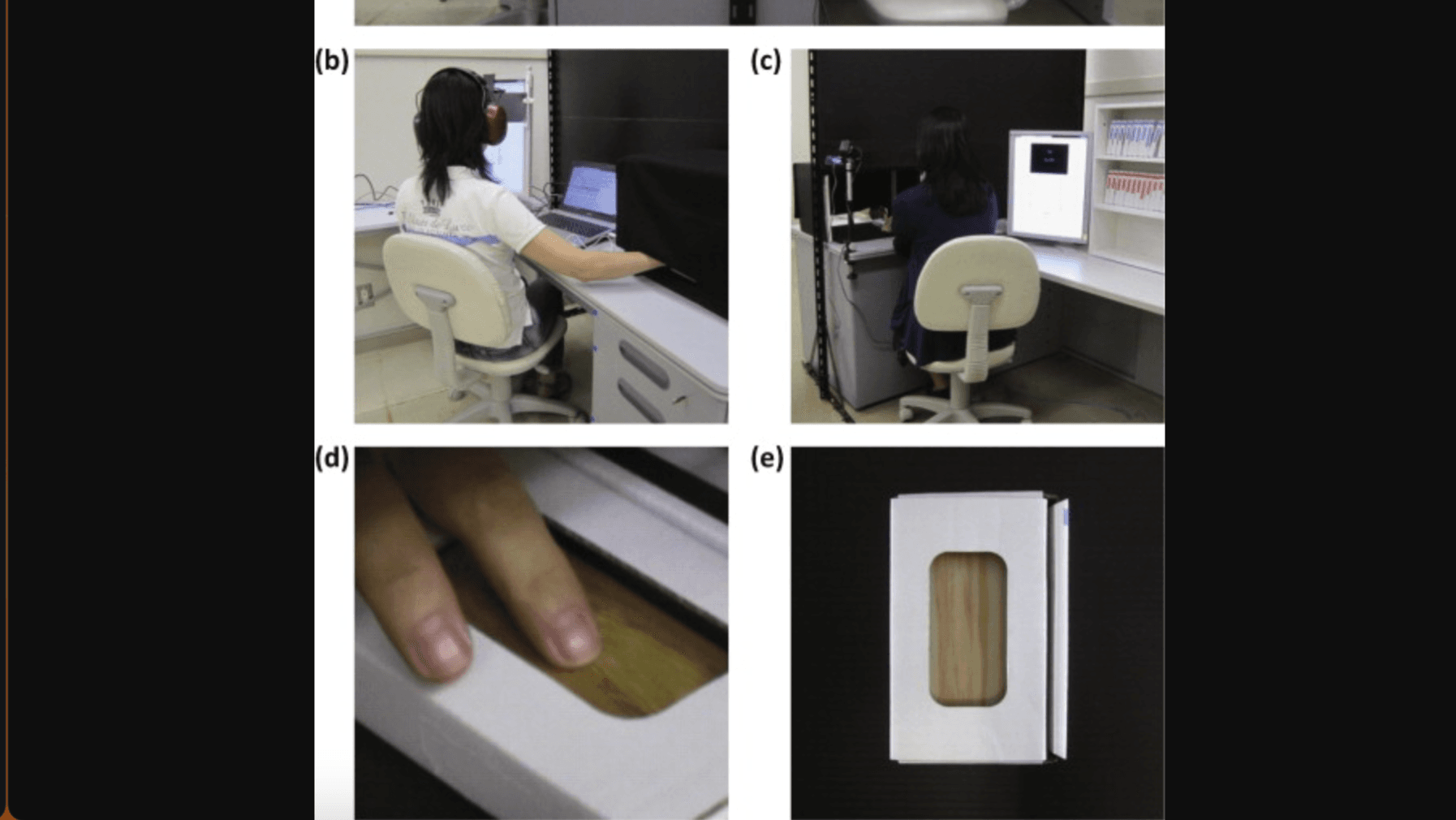
This study examined how people perceive wood through vision, sound, and touch. Across 50 participants and 22 wood types, affective judgments—such as pleasantness, sturdiness, sophistication, and liking—were remarkably similar across senses. Findings suggest that emotional impressions of materials are partly supramodal and closely linked to perceptual qualities.
Vision Research
DOI: https://doi.org/10.1016/j.visres.2014.11.020
Posted bySarah Pearl
Pending staff verification
Notify
Abstract/Description
Most research on the multimodal perception of material properties has investigated the perception of material properties of two modalities such as vision–touch, vision–audition, audition–touch, and vision–action. Here, we investigated whether the same affective classifications of materials can be found in three different modalities of vision, audition, and touch, using wood as the target object. Fifty participants took part in an experiment involving the three modalities of vision, audition, and touch, in isolation. Twenty-two different wood types including genuine, processed, and fake were perceptually evaluated using a questionnaire consisting of twenty-three items (12 perceptual and 11 affective). The results demonstrated that evaluations of the affective properties of wood were similar in all three modalities. The elements of “expensiveness, sturdiness, rareness, interestingness, and sophisticatedness” and “pleasantness, relaxed feelings, and liked–disliked” were separately grouped for all three senses. Our results suggest that the affective material properties of wood are at least partly represented in a supramodal fashion. Our results also suggest an association between perceptual and affective properties, which will be a useful tool not only in science, but also in applied fields.