The impact of social prescribing on well-being outcomes in a nationwide analysis
March 24th, 2026
United Kingdom
Feifei Bu, Daniel Hayes, Luke Munford, Daisy Fancourt
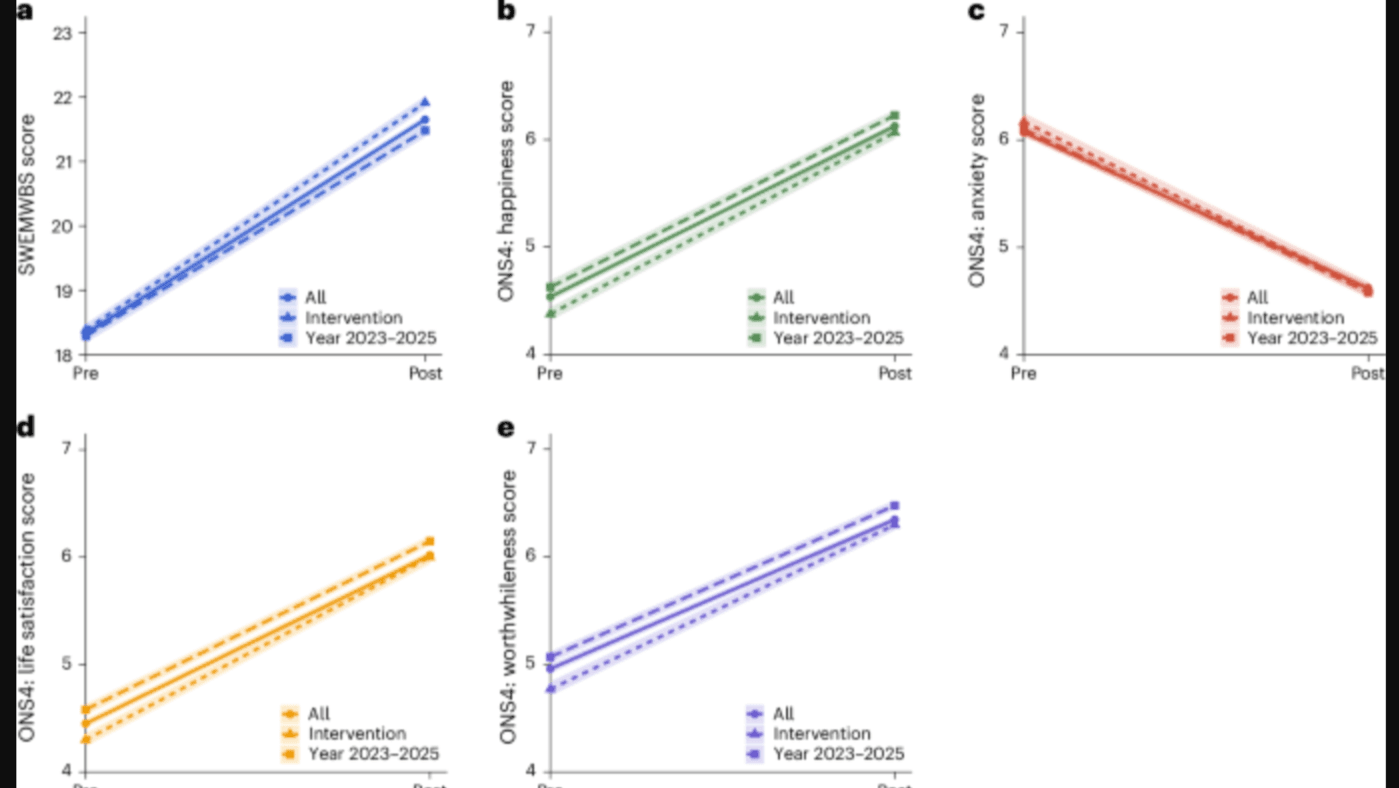
A nationwide UK analysis found that social prescribing- connecting people with community-based, non-medical support- was associated with meaningful improvements in well-being within 1–6 months. Participants reported greater happiness, life satisfaction, purpose, and mental well-being, as well as lower anxiety.
Nature Health
DOI: https://doi.org/10.1038/s44360-026-00099-w
Posted bySarah Pearl
Pending staff verification
Notify
Abstract/Description
This 2026 Nature Health study examined whether social prescribing—referring people to community-based, non-medical support such as arts, exercise, nature, volunteering, and social services—improves well-being. Researchers analyzed longitudinal administrative data from the Access Elemental platform, including 19,627 people assessed with the Short Warwick–Edinburgh Mental Wellbeing Scale and 14,657 assessed with the UK Office for National Statistics well-being measures.
Within one to six months of referral, participants showed substantial improvements across every measured area. Overall mental well-being increased by 3.31 points; happiness rose by 1.59 points; life satisfaction increased by 1.57 points; feelings that life was worthwhile rose by 1.40 points; and anxiety declined by 1.45 points. Results remained consistent across several sensitivity analyses and generally did not vary substantially by age, gender, deprivation, rural or urban location, or referral route, suggesting that social prescribing may benefit diverse populations.
The life-satisfaction improvement was valued at approximately £4,252 per participant over an average of 2.5 months. Based on an estimated referral cost of £466, researchers calculated a return of roughly £9 in well-being benefits for every £1 invested.
The findings provide strong real-world evidence that addressing people’s social, emotional, and practical needs may complement clinical care and improve well-being. However, because the study lacked a control group and included only people who received social prescribing, it cannot establish that the referrals directly caused the improvements. Selection bias, missing data, regression to the mean, and unmeasured influences may also have contributed, so controlled and randomized studies are still needed.
Within one to six months of referral, participants showed substantial improvements across every measured area. Overall mental well-being increased by 3.31 points; happiness rose by 1.59 points; life satisfaction increased by 1.57 points; feelings that life was worthwhile rose by 1.40 points; and anxiety declined by 1.45 points. Results remained consistent across several sensitivity analyses and generally did not vary substantially by age, gender, deprivation, rural or urban location, or referral route, suggesting that social prescribing may benefit diverse populations.
The life-satisfaction improvement was valued at approximately £4,252 per participant over an average of 2.5 months. Based on an estimated referral cost of £466, researchers calculated a return of roughly £9 in well-being benefits for every £1 invested.
The findings provide strong real-world evidence that addressing people’s social, emotional, and practical needs may complement clinical care and improve well-being. However, because the study lacked a control group and included only people who received social prescribing, it cannot establish that the referrals directly caused the improvements. Selection bias, missing data, regression to the mean, and unmeasured influences may also have contributed, so controlled and randomized studies are still needed.