Voices from the Field: Jamie Bennett
What first inspired you to explore the connection between the arts, health, and/or science?
I have seen the connections between the arts and health at pretty much every place I have worked. Early in my career, I worked with Agnes Gund when she was the president of The Museum of Modern Art. I remember accompanying her brother Gordon, who is blind, on a touch tour of MoMA’s Giacometti show and being there when Diane Brown decided to create RxArt and place works of art in hospital settings. At the NYC Department of Cultural Affairs, we had an amazing partnership with the Department for the Aging to integrate arts and cultural strategies into the City’s senior centers, and at the National Endowment for the Arts (NEA), I was floored by some of the amazing work with the Departments of Defense and of Veterans Affairs using arts and culture to address traumatic brain injury and post-traumatic stress disorder, who of the most prevalent wounds of our engagements in Afghanistan and Iraq.
When I was at ArtPlace America, my colleague Jamie Hand, along with Jill Sonke at the University of Florida’s Center for Arts in Medicine, expanded my understanding of the efficacy of arts and culture beyond the clinical setting. They were investigating the roles of arts and culture in public health at the population level.
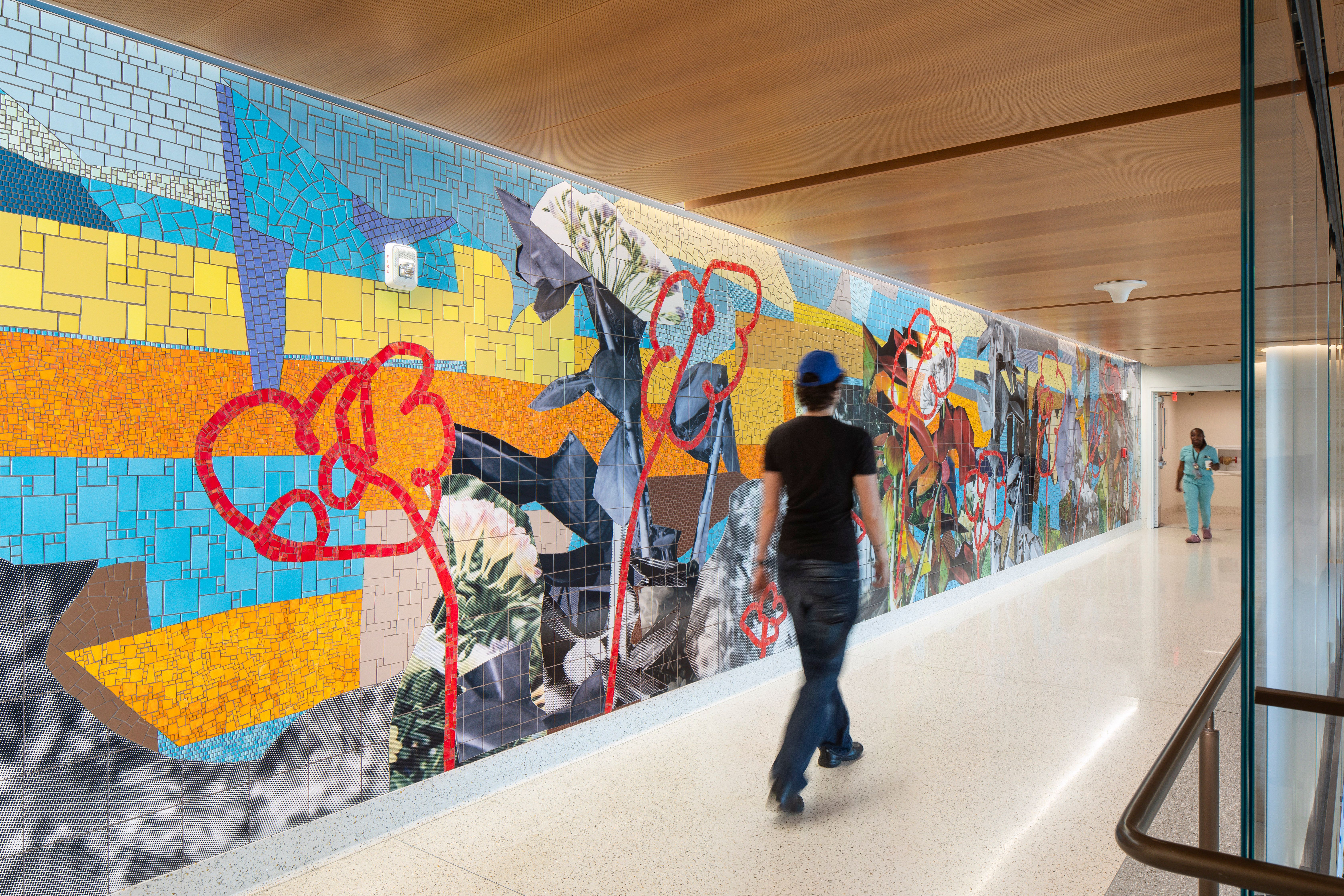 Mickalene Thomas, Freesias on My Mind, 2025. Commissioned by RXART and NYC HEALTH + HOSPITALS/SOUTH BROOKLYN
In your view, what makes the arts and aesthetic experiences uniquely powerful tools for advancing health and wellbeing – and how does your work contribute to translating that potential into practice?
Our colleagues at the Design Studio for Social Intervention (DS4SI) use a 5-S methodology to achieve social change. The first three are fairly expected: system, structure, and scale. The last two are where the arts come in: symbol and sensation.
When I think back about some of the important social movements, I know them by their soundtracks and images. We know the civil rights movement by its soundtrack – “Strange Fruit” being one of the most powerful songs. We remember marriage equality because of the ways that artists and designers used the rainbow to make images that were both celebratory and inclusive.
Maria Rosario Jackson, former chair of the NEA, talks about arts and culture as doing some of the invisible work. She compares them with glue and gas. You tend not to see or think about glue and gas when they are working well. They are invisible. But they are what make things sticky and make things go, and I think this is exactly what DS4SI is describing with “symbol” and “sensation.”
This same stickiness and same go are also useful in health settings: symbols and sensations can be deployed in behavioral health to help individuals make different choices. Dance is sometimes a more fun form of exercise than running. Visual art engages different parts of our brain. Arts and culture are invaluable additions to any doctor’s bag.
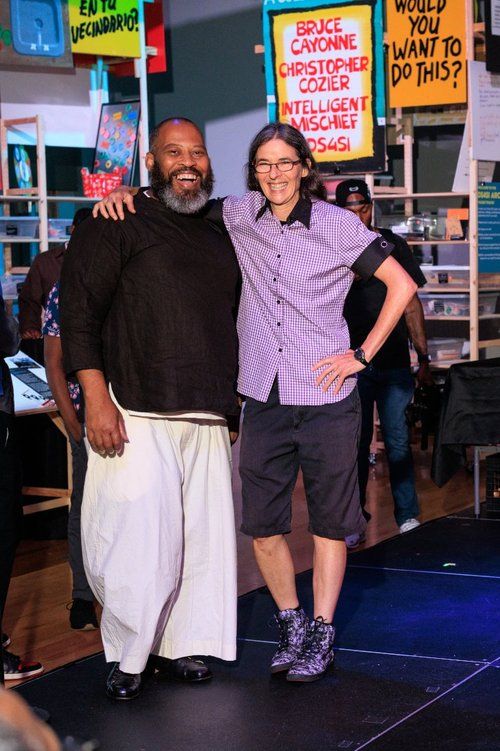 Kenneth Baily and Lori Lobestine, the co-founders of the Design Studio for Social Intervention, who developed “The ‘Five S’ Methodology for Designing Effective Social Interventions: Structure, System, Scale, Symbol and Sensation.”
What challenges do you see in building a more cohesive and equitable neuroarts ecosystem?
I don’t necessarily think about building a single ecosystem so much as about the many ecosystems that neuroarts needs to inhabit. When I think about the intersections of arts and culture with both the physical brain and the consciousness of the mind, I think about clinical health care, public health, academic and applied research, technology development, and on and on…
I think arts and culture play important roles in all those ecosystems, and each ecosystem has to be addressed individually, as there are very different players, environments, and domains in each.
The best thing we could do is begin mapping each of those ecosystems, along with any others we want to occupy, to build roadmaps for integrating each of them.
What kinds of support, collaboration or infrastructure would most help you expand and/or scale your work? What are the existing resources that you have found most useful?
I have always struggled with multiplying work like this at scale. Generally, I have found that if you are interested in getting someone to work differently, the best way to do so is one-on-one or in small groups.
Enlightened self-interest is the most powerful driver of change. If I can show someone how arts and culture can make their work more efficient, more effective, and accessible to more of the population, the person is almost always open to working differently. It is just understanding what a person is trying to do and what obstacles they are facing and then equipping them with examples of what is possible. To misquote a president, it's not asking what someone can do for arts and culture, it’s asking what arts and culture can do for that person.
So, the work isn’t difficult. But it is bespoke and time-consuming. We need people who just do that work: Johnny Appleseeds propagating the ecosystem so that neuroarts can bloom.
Looking ahead, what is one bold idea or hope that you have for the future of neuroarts?
I have become obsessed with the latest work that Mindy Fullilove is doing. Mindy comes out of a public health background, so she was very serious about staying home during COVID. Like many of us, Mindy pretty much watched all of Netflix, and she became enthralled with K-Drama, Korean movies and series. Unlike many of us – or at least unlike me – Mindy decided to be productive during COVID, and she learned Korean and got a Fulbright to visit there. She returned and delivered a series of lectures at Bryan Mawr titled “The Tao of K-Drama.” Those lectures are now being published by Oxford University Press as the first volume in a series on narrative medicine. Her book explores some of the ways that the cultural narratives we tend to hold as Americans are not helpful to our health, and some of the ways that the Korean ones are better. The book is out in September, so I’ll let you wait for that rather than give away more of her thesis.
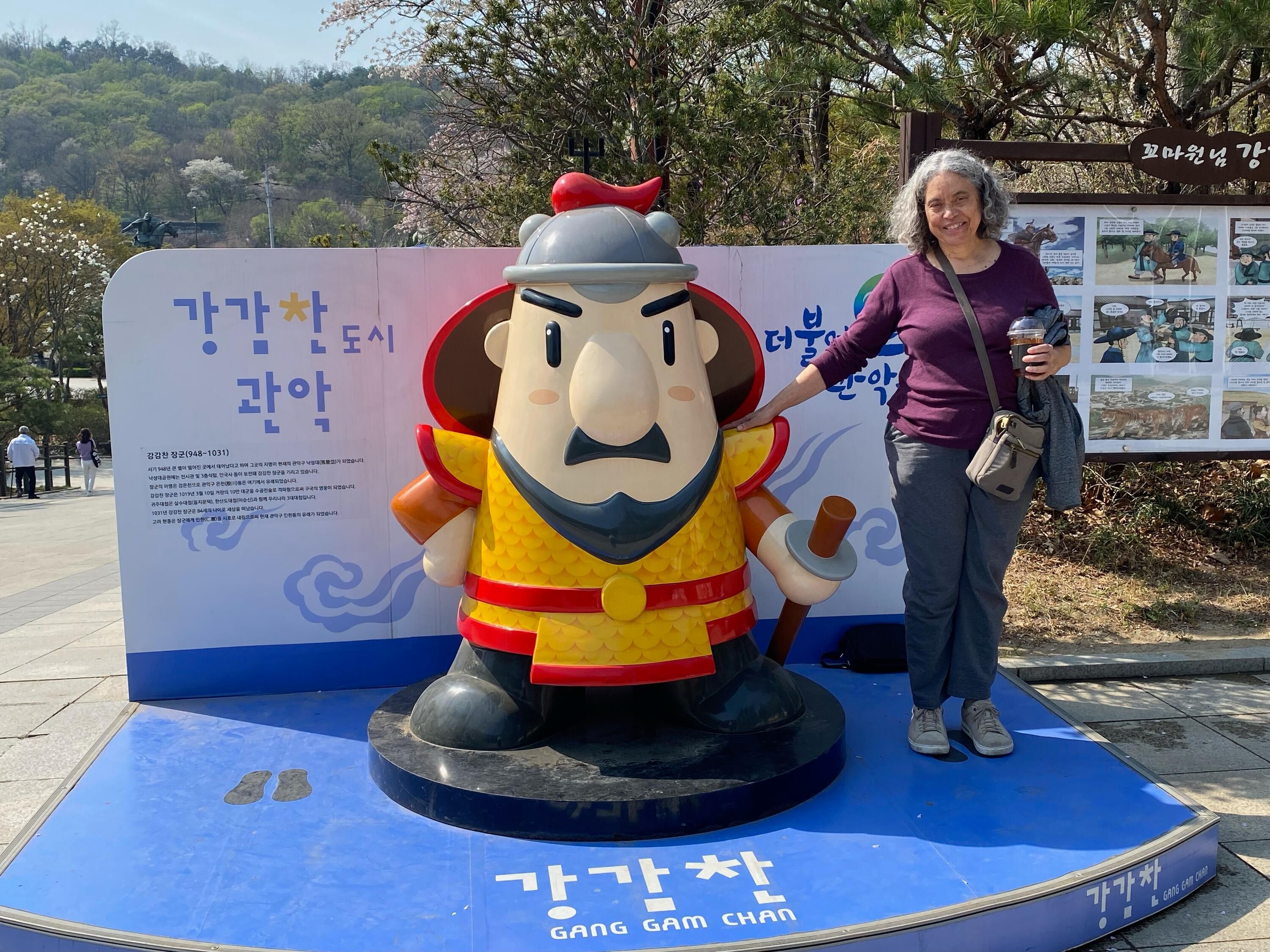 Mindy Thompson Fullilove, MD, during her Fulbright in South Korea, which lead to her writing “The Tao of K-Drama: Wise Narratives for a Troubled World,” forthcoming from Oxford University Press.