Voices from the Field: Rebecca Chamberlain
What first inspired you to explore the connection between the arts, health, and/or science?
I’ve always had a passion for art and spent much of my childhood drawing. While I was a psychology undergraduate student at University College London, I became involved in a project with the Royal College of Art which investigated the impact of learning disabilities like dyslexia on drawing. It was at that moment that I realised it was possible to direct my scientific curiosity toward the arts. I became fascinated in the psychological and neurological foundations of art engagement, particularly what happens in our brains when we learn an artistic skill. Now my research has broadened out, and I have become interested in the role of the body in our experience of art, how we can encourage people to have slower and deeper experiences with art, and how artists and galleries can integrate technology into their work.
In your view, what makes the arts and aesthetic experiences uniquely powerful tools for advancing health and wellbeing—and how does your work contribute to translating that potential into practice?
Making and experiencing art enables us to connect with our bodies, our sensory experience, and our sense of self, often all at once, making it a potent tool for supporting health and wellbeing. However, I want to avoid instrumentalising art too much by suggesting that we should only engage with it to the extent that it advances our health and wellbeing. When Tracey Emin spoke about her recent retrospective at the Tate Modern, she emphasised the fact that art is one of the few human activities that exists purely for its own sake. We should engage with and support art because it is a good in itself. That being said, galleries and museums are quite rightly looking to enhance the wellbeing benefits of their activities. Work I’ve conducted with Dr Sasha Igdalova and Manchester Art Gallery investigated how art galleries can be more mindful spaces. We found that curating spaces intentionally with mindfulness and social interaction in mind, leads to deeper engagement and greater wellbeing benefits for visitors.
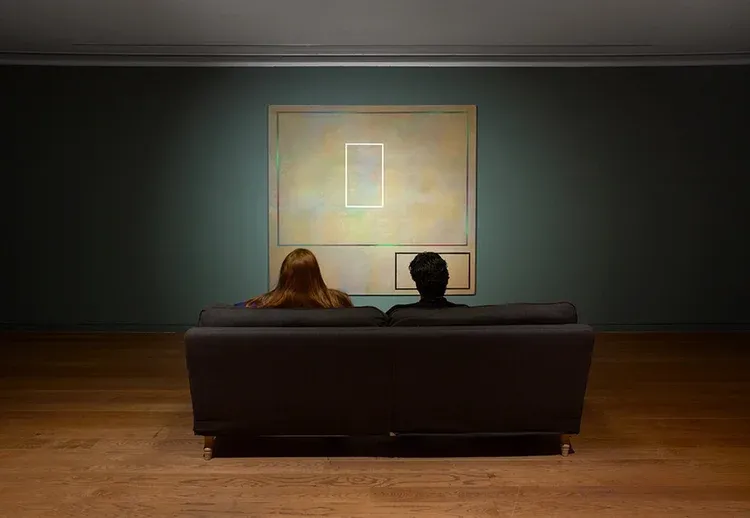 Room to breathe. Courtesy of Manchester Art Gallery
What challenges do you see in building a more cohesive and equitable neuroarts ecosystem?
Access to the arts is still hugely determined by wealth and class. Many people do not feel at home in an arts institution or engaging in arts practice. It is crucial to break down these barriers as it is likely that the people most in need of the arts are those least likely to be able to access it. With this comes a need for political interest and most importantly, funding, for initiatives that engage underrepresented communities. In the UK we can be proud of the fact that we have many freely available arts institutions, but the psychological barriers remain. I think researchers in our field could help to identify these barriers and evaluate initiatives that try to engage diverse audiences.
What kinds of support, collaboration, or infrastructure would most help you expand and/or scale your work? What are existing resources that you have found most useful?
I have found that open-minded working relationships with curators, educators and wellbeing practitioners working in museums and galleries have been fundamental to the success of our research. You must begin the process of scientific research with an appreciation of how your work will be understood and received by the people you are studying, especially if you are concerned with the health and wellbeing benefits of art engagement. Therefore, creating opportunities for individuals from arts and science perspectives to meet and discuss the challenges and possibilities for the field is incredibly valuable. To that end, the Crossroad of Research and Experience of Art (CREA) is a platform that brings together psychological researchers, artists, and cultural practitioners to work collaboratively across disciplines. Additionally, training up the next generation of researchers in neuroarts is vital. At Goldsmiths, University of London, we have an MSc in Psychology of the Arts, Neuroaesthetics and Creativity. Many of our students are passionate about applying their interdisciplinary knowledge and skills to understanding the connection between the arts, health and wellbeing. I hope that we form a small part of the pipeline for developing researchers in this field.
Looking ahead, what is one bold idea or hope that you have for the future of neuroarts?
I would love to see in-house scientific research roles at arts institutions and arts healthcare settings, so that there is more interdisciplinary collaboration between scientists and artists outside of the lab. The problem with academic research at times is that it remains siloed and doesn’t reach the communities that it would best serve. Having a scientist-in-residence programme at some of our arts institutions would illuminate so much about what these wonderful spaces do.