A Community Arts and NeuroArts Field Intervention for Conflict-Displaced Children in Lebanon
June 5th, 2026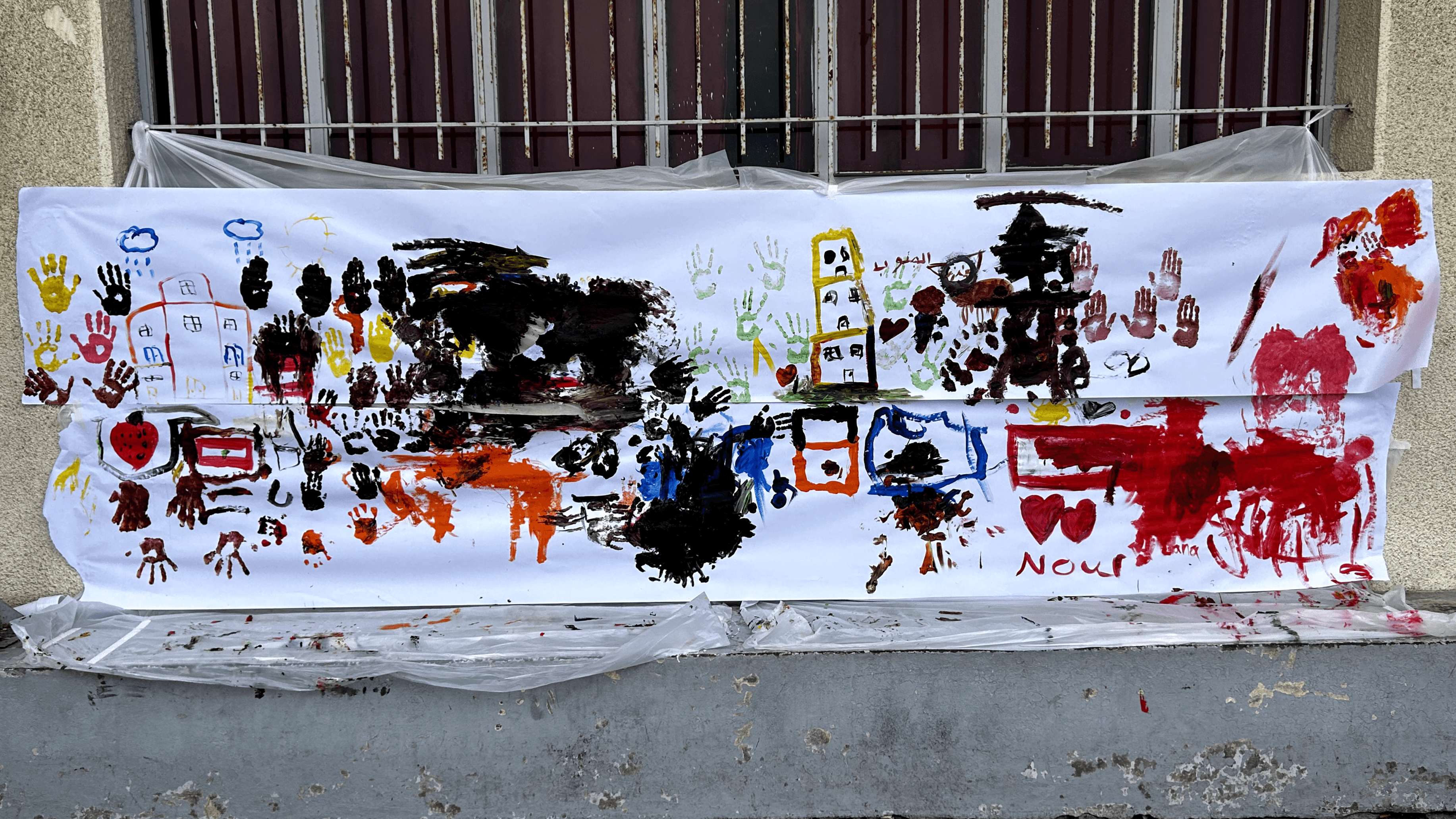
Overview
Revive Baladna is a community arts intervention and NeuroArts field study bringing structured expressive arts workshops and Creative Recovery Kits to 300 conflict-displaced children (ages 8-14) living in humanitarian shelters across North Lebanon and Beirut. The project is designed at the intersection of humanitarian response, arts practice, and applied neuroarts research.
The initiative is implemented on the ground by Tatweer Baladna, a Lebanon-based nonprofit with deep community reach, and is funded through Education Unbound, a registered 501(c)(3) fiscal sponsor in the United States. The research component is being developed in collaboration with a researcher from Northeastern University and is currently undergoing IRB submission at the University of Texas at Dallas.
Revive Baladna represents a rare example of a rigorous neuroarts intervention deployed within an active humanitarian context- one of the most underrepresented populations in the global neuroarts literature.
The Problem This Work Addresses
For children living through conflict and displacement, access to creative expression is not supplemental- it is foundational recovery. The accumulated evidence base in neuroarts confirms that art-based interventions measurably reduce cortisol, support autonomic nervous system regulation, improve emotional self-regulation, and promote resilience in populations facing trauma and adversity.
Yet conflict-affected children in humanitarian settings remain one of the least-studied populations in neuroarts research. There is almost no peer-reviewed field study data on arts-based psychosocial intervention in this population, and no established, replicable protocol for measuring outcomes in shelter environments.
Revive Baladna is designed to address that gap directly, generating field data while simultaneously delivering care.
The Arts Practice
Workshop Structure
Each Revive Baladna workshop is a 2-3 hour guided expressive arts session for 30 children. Workshops begin with collective art-making on kraft paper, a single shared surface where many hands work together, facilitated by local artists with deep roots in the Lebanese community.
Creative Recovery Kit
Each child receives a Creative Recovery Kit containing journals, watercolors, oil pastels, colored pencils, a sketch pad, and a welcome card in Arabic and English. The kit is theirs to keep long after the workshop ends, providing continued access to creative expression in the shelter setting.
The kit is designed in alignment with trauma-informed principles: it emphasizes child ownership, removes pressure for "correct" outcomes, and provides tactile and expressive tools that do not require literacy to use.
Facilitator Approach
Workshop facilitators are briefed on the structured behavioral observation protocol and the emotional check-in instrument. The session design intentionally creates conditions for creative flow, sustained, intrinsically motivated engagement with the art-making process, which the research literature identifies as a key mechanism for stress reduction and emotional regulation.
The Research Protocol
Revive Baladna includes a layered measurement protocol designed to generate publishable field data on arts-based psychosocial intervention in conflict-displaced children.
Measurement Architecture
- Self-report affective state: Bilingual Arabic/English emotion wheel instrument administered at T0 (baseline, before workshop), T1 (mid-session, 45 minutes in), and T2 (post-intervention, immediately after the workshop). The T1 mid-session measurement is a distinctive feature of this protocol, designed to capture the intervention in process rather than only its aftermath.
- Structured behavioral observation: Facilitators complete a per-child observation checklist assessing engagement level, verbal expression, body language, and creative risk-taking at T0 and T2.
Study Design
The study is designed with two groups: a sustained ABPI cohort (longitudinal, repeated workshops) and an acute ABPI cohort (single workshop).
Primary Research Questions
- Does a structured expressive arts intervention produce measurable acute reductions in self-reported affective distress among conflict-affected displaced youth?
- Does repeated exposure produce greater emotional regulation outcomes than a single session?
- Does the degree of flow experienced during the session predict the magnitude of emotional improvement?
IRB and Ethics
IRB submission is in progress at the University of Texas at Dallas. Tatweer Baladna is simultaneously pursuing ethics board approval in Lebanon. All data collection uses anonymized participant codes. Guardian consent and child assent procedures are bilingual Arabic/English. Child photography follows strict consent and protocols in alignment with international child safeguarding standards.
Connection to the NeuroArts Field
Revive Baladna draws explicitly on the neuroarts evidence base across multiple theoretical frameworks:
- Neuroaesthetics: creative engagement activating reward and motor circuits (Chatterjee, 2011; Vessel et al., 2012)
- Somatic trauma processing: the body as the site of trauma storage and healing (van der Kolk)
- Arts-based intervention research: community arts as structured health intervention (Golden, Sonke et al., Arts on Prescription Field Guide, 2023)
- Flow theory: intrinsically motivated creative engagement as the mechanism for stress reduction (Csikszentmihalyi)
The research directly responds to the call in the 2025 Leonardo Focus Introduction on Neuroarts (Magsamen and Edwards, Vol. 58 No. 6) for 'large-scale targeted neuroarts interventions' to 'promote resilience in those facing trauma' and for field studies in 'underserved communities' that bring researchers and practitioners together.
This work also aligns with the NeuroArts Blueprint's equity imperative: the benefits of neuroarts must be 'readily, consistently, and equitably accessible to all populations across the lifespan and in every community around the world.'Conflict-displaced children in Lebanon are precisely this kind of population, one the field urgently needs to reach and study.
The Founder's Story and Lived Experience
Weeda Hamdan is a Lebanese-American visual artist and NeuroArts researcher at the University of Texas at Dallas (School of Interdisciplinary Studies). She is the founder of Education Unbound and a graduate researcher whose practice spans painting, installation, biofeedback technology, and applied neuroarts research.
When she was 12 years old, she was a child in a shelter. War and displacement had taken everything familiar. In the middle of that uncertainty, art became her only certainty, the one place she had agency, expression, and a way through.
Revive Baladna is the direct extension of that lived experience into research and practice. Her position as a person with lived experience in the target population is not incidental to the research; it is epistemological. In the framing of arts-based research methodology, lived experience is a legitimate and rigorous research lens, not a bias to be disclosed.
Scale, Impact, and Timeline
Children reached (Phase 1 + Phase 2): 300 children
Workshops: 10 sessions, 30 children each
Locations: North Lebanon and Beirut humanitarian shelter sites
Implementation partner: Tatweer Baladna (Lebanon)
Fiscal sponsor: Education Unbound (501c3, US)
Workshop facilitators: Lebanese artists
Research collaborator: Dr. Mariya Vodyanyk, Northeastern University
First workshop completed: April 9, 2026, Bchamoun School, Lebanon
Campaign goal: $30,000 — $100 per child
Publication and Dissemination Intent
The dataset generated across 10 workshops and 300 children is designed for peer-reviewed publication in journals including NeuroArts, Arts in Psychotherapy, or Frontiers in Psychology. The protocol is also being developed as part of a dissertation in Interdisciplinary Studies at UTD, with the potential to contribute a replicable field methodology for arts-based intervention in humanitarian contexts.
Revive Baladna is committed to open dissemination of the research findings back to the Lebanon community, to Tatweer Baladna as implementers, and to the global neuroarts community through channels including the Neuroarts Resource Center.