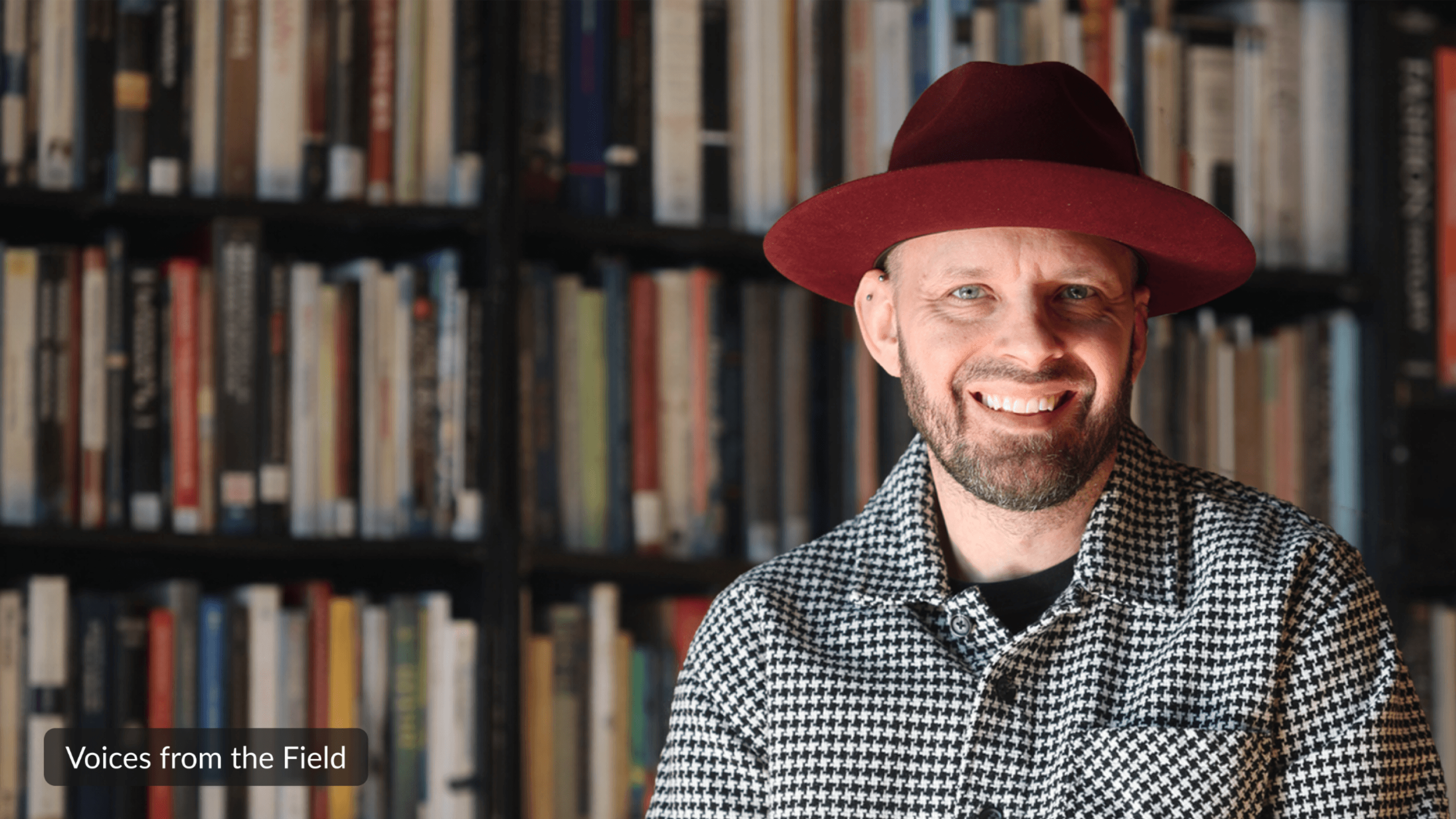
Voices from the Field: Michael Spicher
What first inspired you to explore the connection between the arts, health, and/or science?
I remember seeing images comparing certain public school interiors with prisons. The similarities were difficult to ignore. That moment crystallized something I had been circling around philosophically: our environments are not neutral. They shape us.
That realization drew me toward Aristotle’s concept of flourishing (eudaimonia), which is not about comfort or productivity, but about the development of character and judgment over time. Flourishing depends on formative conditions. Modern life tends to measure what is easy to quantify: outcomes, efficiency, throughput. Aesthetics rarely fits neatly into those categories, so it is often treated as secondary. Yet the spaces we inhabit quietly orient our dispositions, expectations, and interactions. If flourishing involves the cultivation of character, then aesthetic conditions are not trivial. They participate in that cultivation.
In your view, what makes the arts and aesthetic experiences uniquely powerful tools for advancing health and wellbeing—and how does your work contribute to translating that potential into practice?
Aesthetic experience shapes us at a level deeper than explicit instruction. Before we articulate reasons or policies, we are already being oriented by form: by light, proportion, rhythm, texture, and atmosphere. These elements influence how we feel, what we attend to, and how we relate to others. Over time, they contribute to the development of habits and expectations.
John Dewey observed that there is an aesthetic dimension to all experience, not just to encounters with art. While we often reserve the word “aesthetic” for dramatic examples—a cathedral that inspires awe or a prison that provokes discomfort—most of our lives unfold in ordinary spaces. Those spaces may not shock us, but they still shape us. The absence of intensity does not mean the absence of influence.
Research in product design shows that people tend to perceive aesthetically refined products as higher in quality. Form communicates value. The same dynamic operates in organizations. What message is conveyed when workspaces and common areas feel neglected? Conversely, what is communicated when environments are designed with care? In healthcare, even excellent clinical practice can be undermined if the surrounding environment signals stagnation or disregard.
In my work with leaders and institutions, I focus on this formative dimension of aesthetic life. Drawing on philosophy and my training in philosophical counseling, I facilitate reflective conversations that sharpen practical judgment. This is what Aristotle would call phronesis, the capacity to discern what a situation calls for and act accordingly. The aim is not superficial beautification, but alignment: ensuring that an organization’s physical and cultural forms reinforce its stated values and genuinely support the wellbeing of those within it.
This commitment led me to found the Aesthetics Research Lab in 2016. Through ARL, I developed a workshop called Aesthetics at Work, which I’ve delivered to organizations including Arcaea. The workshop invites teams to examine how their environments, design decisions, and everyday aesthetic choices communicate values and shape institutional culture. The goal is not to impose a particular style, but to cultivate greater awareness of how aesthetic form participates in the health of an organization.
 Aesthetics Research Lab, founded by Michael Spicher, turned 10 in 2026
What challenges do you see in building a more cohesive and equitable neuroarts ecosystem?
One challenge is fragmentation. Neuroarts can remain siloed within academic research, or it can become overly instrumentalized, reduced to a collection of measurable variables detached from lived experience. What is needed is integration, guided by practical wisdom.
Applying research about aesthetics is not like solving a formula. Studies may suggest, for example, that curvature in architecture can foster a sense of safety. But that does not mean all curvature is equally appropriate in every setting. Philosophers have long discussed proportion as a condition of beauty, yet proportion can be realized in many diverse ways. Moving from general findings to particular contexts requires cultivated judgment. Without this dimension, well-intended insights can become rigid prescriptions.
Equity adds another layer of urgency. If aesthetic environments genuinely shape wellbeing, cognition, and social behavior, then the question of who has access to thoughtful, dignified spaces becomes unavoidable. In many cities, affluent neighborhoods and institutions receive aesthetic investment as a matter of course, while under-resourced schools, clinics, and public spaces are treated as though beauty were a luxury they cannot afford. A cohesive neuroarts ecosystem must hold both challenges simultaneously: the conceptual work of integration and the ethical work of fair distribution. Otherwise, we risk building a sophisticated body of knowledge that serves only those who already have the most.
What kinds of support, collaboration, or infrastructure would most help you expand and/or scale your work? What are existing resources that you have found most useful?
What would most accelerate this work is infrastructure that supports translation: ongoing partnerships where philosophical insight and empirical research inform real-world design and leadership.
Too often, people remain largely within their own domains of research or practice. We need sustained interdisciplinary and inter-professional collaboration. Architects, designers, healthcare leaders, educators, philosophers, and neuroscientists each approach aesthetics from distinct perspectives. Shared projects and a shared vocabulary are essential if we are to move from theory to transformation. Part of this collaboration requires better training in how to communicate science to the public without overstating or overpromising, which can ultimately undermine trust in the research.
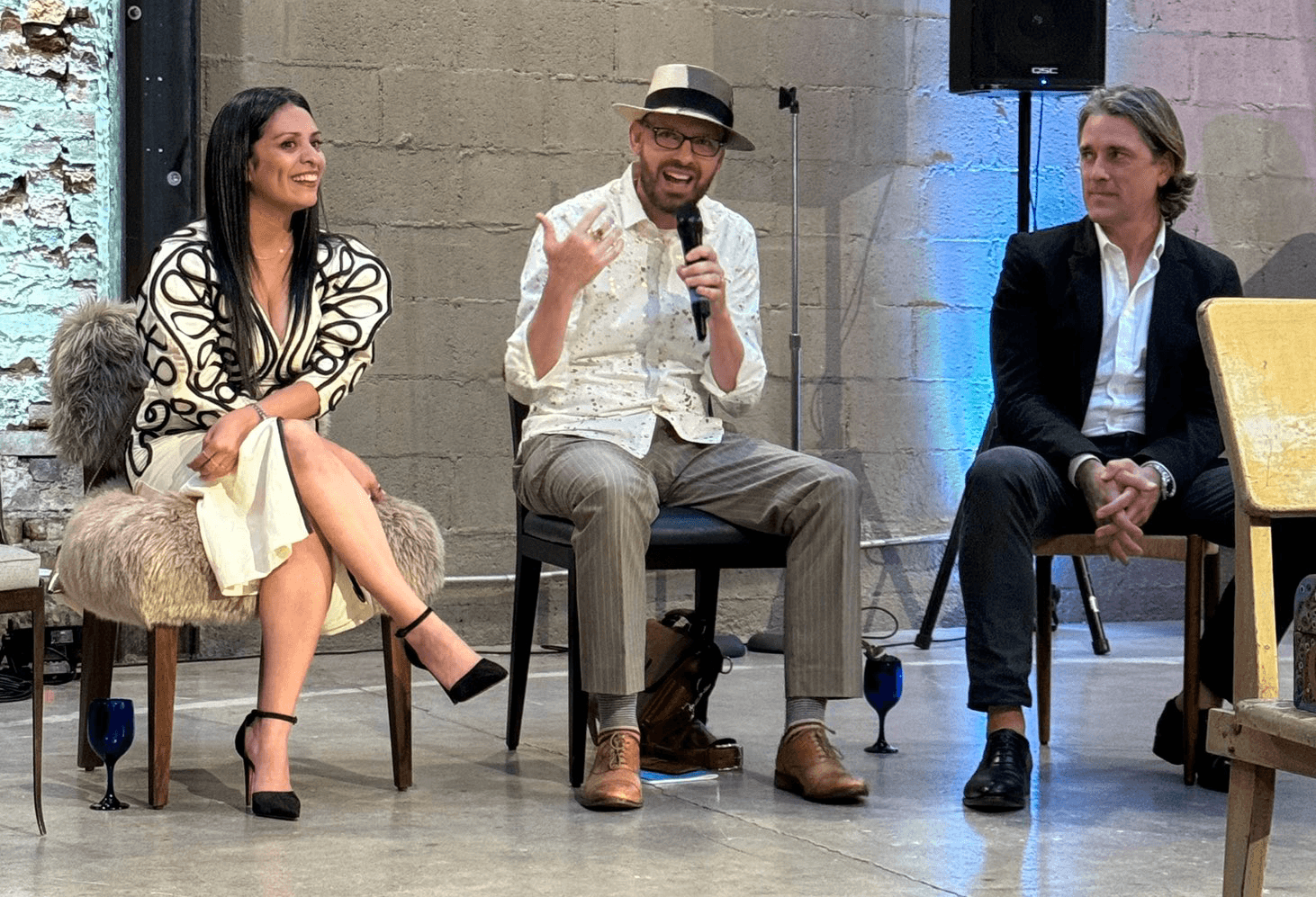 Michael Spicher speaking on a panel on the topic of Beauty and Sustainability. Other panelists were Mel Saenz of Juniper Lighting Design and William Stuart owner of Costantini Design. Photo credit: Kaile Smith
Clarity of terms is especially important. “Aesthetics” is frequently conflated with “art,” which narrows its scope considerably. Aesthetics concerns the forms and atmospheres that condition everyday life, not only objects displayed in galleries. Greater conceptual precision strengthens collaboration across fields.
Pilot programs and sustained partnerships are especially important. The most meaningful change happens when organizations are willing to examine, over time, how their spaces, culture, and daily practices shape the people within them. That kind of iterative, research-informed process is difficult to replicate in a one-time consultation. Institutions open to sustained engagement can become demonstration sites, showing what it looks like when aesthetic consideration is treated as integral rather than incidental.
Looking ahead, what is one bold idea or hope that you have for the future of neuroarts?
My hope is that aesthetic literacy becomes foundational in leadership, education, and healthcare, so that beauty and meaningful design are understood as essential conditions for human flourishing rather than optional enhancements.
Empirical aesthetics has reinforced many longstanding philosophical insights about the formative power of beauty and form. We now have growing evidence that environments influence stress, cognition, recovery, and social behavior. The next step is cultural: those with authority and resources must treat aesthetic considerations as integral to their mission.
A nurse friend once described his hospital’s circadian lighting and restorative spaces for staff. Visiting nurses sometimes refer to it as the “bougie” hospital. That reaction is revealing. Why should thoughtful, humane design be seen as indulgent rather than normal? Aesthetic conditions are not merely cosmetic additions to human life; they are part of the architecture of human flourishing.
I imagine a future in which we no longer apologize for valuing beauty. Instead, we would be surprised by environments that disregard it. Neuroarts has the potential to help reframe aesthetics as a shaping force in human life, one that determines how we design the spaces in which we work, learn, heal, and live.